Traditional Security Information and Event Management (SIEM) platforms are breaking under the weight of modern telemetry. As cloud data volumes explode, security teams face massive ingestion costs, severe detection latency, and unsustainable storage requirements. A SIEM-Less architecture offers a viable SIEM alternative, decoupling threat detection from log centralization to process data where it lives. Last updated: October 2026.
Key Takeaways
Architectural Decoupling: True SIEM-Less architecture separates threat detection from data storage, analyzing telemetry at the source or in transit rather than forcing all data into a centralized, indexed repository.
Operational Shifts: Correlation runs where data lives or as it moves in a SIEM-Less architecture, enabling detection rules to fire in seconds instead of waiting minutes or hours for log ingestion.
Evaluation Criteria: The viability of a SIEM-Less platform hinges on its ability to handle compliance reporting, telemetry normalization, and parallel deployment natively, without shifting the engineering burden to your team.
Cost Realities: Mid-market SIEM deployments cost $200K–$600K annually once staffing and data retention are included, while enterprise 24/7 SOC operations scale to $2M–$8M per year.
Retaining Visibility: SIEM-Less architecture relies on customer-owned object storage and on-demand queries instead of expensive, proprietary SIEM indexing, fully maintaining compliance and visibility.
Table of Contents
What Is a SIEM-Less Architecture?
How a SIEM-Less Architecture Works
Benefits and What to Look For
SIEM vs. SIEM-Less: Choosing the Right Model
Frequently Asked Questions (FAQ)
Summary & Next Steps
What Is a SIEM-Less Architecture?
A SIEM-Less architecture decouples threat detection from centralized log storage. By running correlation at the source or in transit, this model eliminates the requirement that all data must be indexed first. Security teams gain faster detection capabilities and reduce storage costs without sacrificing visibility.
Definition: A SIEM-Less architecture is a security operations framework that processes, analyzes, and correlates telemetry across distributed environments before or without centralizing it into a traditional SIEM platform. Industry analysts like Gartner categorize this approach under the Security Data Lake (SDL) plus Best-of-Breed path — ReliaQuest's GreyMatter platform operationalizes this model as a SIEM-Less architecture, emphasizing that core SIEM functions (detection, correlation, investigation) persist while the centralized indexing model does not.
Clarifying the SIEM-Less Model
The term "SIEM-Less" suffers from intense vendor dilution. To evaluate this architecture accurately, security leaders must first strip away the marketing noise and understand the operational realities.
Compliance and Logging Remain Mandatory
Moving away from a traditional SIEM does not excuse organizations from compliance mandates. Security teams must still retain log data for auditing and regulatory frameworks — including PCI-DSS, SOC 2, SEC four-day material incident disclosure rules (effective 2024), and CIRCIA 72-hour reporting requirements for critical infrastructure. The critical difference lies in where and how that data lives. Instead of paying premium per-gigabyte ingestion fees for active, hot-indexed SIEM storage, teams route data to cost-effective object storage such as AWS S3, Google Cloud Storage, or Azure Blob. Compliance is maintained through on-demand querying capabilities against those raw storage buckets. The speed advantage of in-transit detection helps teams identify and validate incidents faster, supporting readiness for the compressed reporting timelines that SEC and CIRCIA mandate.
Detection Must Move Faster Than Storage
The SIEM-Less model is also about speed. AI is helping attackers move faster, automate more of the attack chain, and compress the time defenders have to detect and respond. A traditional SIEM-dependent model waits for logs to be ingested, parsed, and stored before detection can occur—creating latency. In a SIEM-Less architecture, detection can happen through direct source connections or as normalized data moves through a pipeline, reducing MTTD and helping teams initiate response before threats progress.
MDR-Managed SIEMs Do Not Qualify
Many Managed Detection and Response (MDR) providers claim to offer "SIEM-Less" services simply because they manage the SIEM on your behalf. If the underlying technology still relies on centralizing and indexing all logs before detection can occur, it operates as a traditional SIEM architecture — just outsourced. True SIEM-Less involves a fundamental architectural decoupling of detection from storage. Build toward an operational model rather than purchasing a point solution wrapped in a service contract.
The pressure to adopt true architectural decoupling is largely financial. Traditional setups demand heavy investments in infrastructure and personnel, with industry TCO models consistently showing SIEM staffing costs running two to three times the software license itself (Gartner Security Operations Research).
How a SIEM-Less Architecture Works
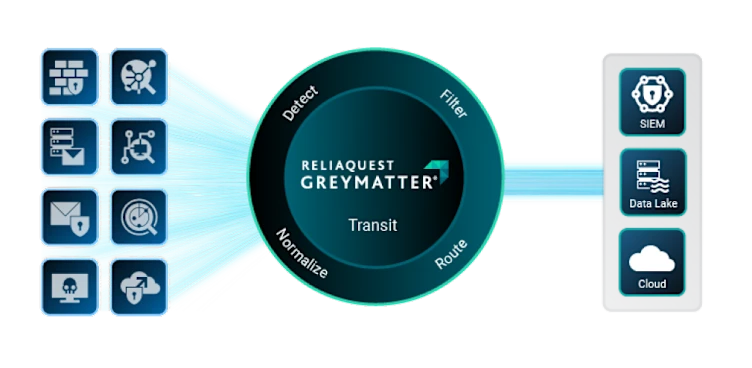
A SIEM-Less stack replaces the centralize-everything model with four distinct layers: data normalization, in-transit detection, AI-driven triage, and selective storage. This approach processes telemetry where it originates, minimizing latency and eliminating the massive ingestion bottlenecks that plague traditional security operations.
Core Architectural Layers
The transition from a centralized SIEM to a decoupled architecture requires rebuilding the data pipeline to support distributed operations. A mature SIEM-Less model operates across four foundational layers:
Security Data Pipelines and Normalization: Before you can detect outside the SIEM, disparate data must be standardized. Telemetry from cloud environments, endpoints, and identity providers speak entirely different languages. In a decoupled model, this data normalizes in transit. The GreyMatter platform's Universal Translator automatically normalizes telemetry across 300+ integrations, ensuring raw data is uniform and query-ready without requiring your analysts to write custom parsers.
Detection in Transit and at Source: Instead of waiting for logs to land in a database and undergo indexing, detection engines apply correlation rules to normalized data as it moves through the pipeline or directly via APIs at the source. This stream-processing approach identifies malicious patterns immediately.
AI-Driven Triage and Response: Once a detection fires, GreyMatter's AI Teammates and automated incident response immediately retrieve relevant data from object storage or directly from source technologies to investigate the alert. These automated systems generate an investigation plan, review historical context, and collect logs and evidence from available telemetry—including the data that is landed in storage—before a human analyst opens the ticket.
Cost-Effective Object Storage: After processing, logs route to long-term object storage that you own and control. When deep investigations or compliance reporting are required, federated search capabilities enable analysts to query stored data on demand, completely bypassing traditional SIEM indexing costs while safely retaining data for 12 months or more.
What Changes for the SOC
For the Security Operations Center (SOC), the practical shifts are profound. Analysts no longer wait 15 to 30 minutes for logs to be ingested, indexed, and made searchable. Detection fires in seconds. Furthermore, analysts query data where it lives instead of logging into a centralized dashboard containing only the subset of telemetry the organization could afford to ingest.
Benefits and What to Look For
SIEM-Less architectures reduce detection latency, cut storage costs, and eliminate vendor lock-in. However, the gap between the promise of this model and operational reality depends entirely on platform maturity and how much engineering burden shifts back onto your security team.
Where SIEM-Less Delivers
This speed and capacity dictate survival in the modern threat landscape. Enterprise SOCs process thousands of alerts per day — research from Vectra AI found that teams face an average of 4,484 alerts daily, with 67% going uninvestigated (Vectra AI 2024 State of Threat Detection). Separate Forrester research places enterprise alert volumes as high as 11,000 per day (Forrester, 2023). A SIEM-less architecture reduces ingestion dependency and detection latency, while deduplication engines and AI-driven investigations help reduce alert noise and uninvestigated backlog.
When executed correctly, decoupling detection from storage yields significant operational advantages:
Cost Reduction: Forrester's Total Economic Impact analysis found organizations achieved $1.9 million in direct storage and tool consolidation savings over three years by eliminating redundant SIEM ingestion (Forrester Total Economic Impact of ReliaQuest). By routing bulk telemetry to cold or warm object storage instead of hot SIEM indexes, teams reclaim budget previously consumed by premium SIEM ingestion and storage costs.
Faster MTTD (Mean Time to Detect): Analyzing data at the source or in transit cuts detection latency from minutes to seconds, directly closing the window attackers use to move laterally.
Expanded Visibility: Because cost is no longer a limiting factor for data ingestion, security teams gain the freedom to monitor high-volume sources — like DNS logs, firewall drop traffic, and cloud VPC flow logs — previously excluded from the SIEM due to prohibitive pricing.
Architectural Control: Retaining telemetry in your own infrastructure eliminates vendor lock-in. Organizations own their security data and control access to it.
The gap between SIEM-Less promise and SIEM-Less reality comes down to platform maturity. Evaluate whether a solution handles normalization and migration natively — or pushes that engineering burden onto your team.
What to Evaluate in a SIEM-Less Platform
Not all platforms deliver on the architectural promise. Reframing common implementation challenges as strict evaluation criteria protects your team from adopting a solution requiring excessive custom engineering. When reviewing vendors, demand exact answers to these questions:
"Does it handle compliance reporting natively, or will your team build that from scratch?" Look for platforms offering saved searches and out-of-the-box reporting to meet compliance mandates. Without this, your engineers will spend months building manual dashboards over a data lake.
"Can it normalize telemetry across vendors without custom engineering?" If your team must build and maintain data parsers for every tool in your stack, you have simply traded SIEM licensing costs for data engineering salaries. Normalization must happen automatically.
"Does migration require ripping and replacing, or can you run in parallel?" The safest transition strategy is a parallel operation model. Organizations must run a SIEM-Less architecture alongside the existing SIEM, slowly migrating use cases to avoid coverage gaps.
This rigorous evaluation is critical because the financial stakes are massive. Mid-market SIEM deployments cost $200K–$600K annually once data retention, tuning, and staffing are factored in (UnderDefense 2026 SIEM TCO Study). For enterprises running 24/7 SOCs, total operational costs scale to $2M–$8M per year when combining platform licensing with the staffing required to combat constant alert fatigue in the SOC.
SIEM vs. SIEM-Less: Choosing the Right Model
The right architecture depends on your team's maturity, compliance requirements, and data volume — not on which vendor label sounds more modern. Evaluate the environment honestly to determine whether a traditional SIEM or a decoupled architecture best aligns with operational realities.
In recent market analyses, Gartner's three-path evolution framework (Gartner, 2025) outlines the real choices buyers face: staying with a Classic SIEM, moving to an Integrated SOC (ISOC), or adopting a Security Data Lake (SDL) plus Best-of-Breed tools. A SIEM-Less architecture aligns heavily with the SDL and Best-of-Breed path, optimizing for environments generating massive data volumes.
Comparison Table
Capability | Traditional SIEM | SIEM-Less Architecture |
|---|---|---|
Detection Speed | Moderate to Slow (delayed by ingestion and indexing phases) | Fast (detection occurs in transit or at the source) |
Compliance Readiness | Native, out-of-the-box dashboards and centralized reporting | Raw and normalized telemetry is maintained in object storage at a fraction of the cost, supporting long-term retention and searchable reporting. |
Engineering Requirements | High maintenance of proprietary correlation rules and custom parsers | Lower maintenance, provided the platform includes automated normalization |
Vendor Lock-In | High (data is trapped in the vendor's proprietary format) | Low (data is normalized in a universal schema like OCSF for use across other tools) |
Best Fit | Organizations wanting a single bundled platform and simple reporting | Teams prioritizing execution speed, scale, and long-term cost control |
When Each Model Fits
If your team is small, highly reliant on out-of-the-box dashboards for basic compliance audits, and lacks the resources to manage cloud infrastructure, a traditional SIEM or an ISOC platform serves your needs effectively.
However, if your data ingestion costs are spiraling out of control, your detection latency leaves you exposed to fast-moving threats, and you want strict control over your own telemetry, transition to a SIEM-Less model. Organizations do not have to cut over overnight. Deploy a parallel operation model, running SIEM-Less capabilities for high-volume cloud logs while maintaining the legacy SIEM for core alerts during the transition phase.
GreyMatter SIEM-Less solution brief
Frequently Asked Questions (FAQ)
Is SIEM-Less the same as having no SIEM?
No. A SIEM-Less architecture does not mean an organization has less security monitoring. It means decentralizing the core functions of a SIEM — log aggregation, correlation, searching, alerting, and reporting — so they occur dynamically across the environment rather than inside a monolithic, centralized database, providing equal or better visibility.
Can a SIEM-Less architecture meet compliance requirements?
Yes. Compliance frameworks mandate data retention, integrity, and audibility — not a specific software category. SIEM-Less architectures fulfill these requirements by routing audit logs to secure, cost-effective object storage where analysts query them directly for reporting, including the compressed timelines mandated by SEC and CIRCIA disclosure rules.
What skills does a SOC need to operate SIEM-Less?
SOC analysts require strong investigation skills and deep familiarity with federated search mechanisms. Because AI Teammates handle initial triage and normalization happens dynamically, analysts spend significantly less time writing custom parsers and more time actively tracing complex attack paths across the enterprise environment.
How long does a SIEM-Less transition take?
Transition timelines vary, but best practices dictate a phased approach rather than a hard cutover. By deploying a parallel operation model, organizations can route net-new high-volume data sources to the SIEM-Less architecture immediately, fully migrating legacy logs over time.
How do you evaluate SIEM-Less platforms?
Evaluate vendors based on their native data normalization capabilities, storage location flexibility, and real-time detection latency. A mature platform offers pre-built data connectors, applies detections dynamically in transit, and allows organizations to retain raw data securely in their own cloud infrastructure.
Summary & Next Steps
Navigating the complexities of modern security telemetry requires breaking free from legacy ingestion models. A true SIEM-Less architecture decouples detection from storage, dramatically reducing latency and licensing costs while improving coverage across the environment. By normalizing data in transit, applying at-source detection, and using customer-owned data lakes, organizations achieve the capabilities of a robust security program without debilitating SIEM tradeoffs.
A SIEM-Less architecture equips your team to take control of security operations and stop paying to store noise.
Dive deeper into ReliaQuest's SIEM optimization solutions to bridge the gap during your operational transition.