Frost & Sullivan named ReliaQuest a Visionary Leader in the Frost Radar™: AI Security Operations Centers, 2026. We earned a perfect Innovation Index score of 5.00.
Frost evaluated more than 60 companies in the AI SOC market and plotted 23. It defines Visionary Leaders as companies that “deliver transformative technologies, business models, and processes” and “influence industry direction and set new benchmarks.”
We believe a perfect Innovation score points to one thing. The AI SOC is an architecture decision, not a feature race.
The AI SOC Market Is Moving Past Point Solutions
Frost forecasts that the AI SOC market will grow from about $7.6 billion in 2026 to $18.9 billion in 2029, a 35.5% compound annual growth rate. Financial services leads adoption. Healthcare, manufacturing, government, and technology and telecom are close behind.
Frost’s findings match what we hear from security leaders every week:
Security operations now exceed the speed and scale at which human analysts can respond.
Attackers use AI to speed up recon, adapt faster, and run more advanced attacks.
Feature breadth is not enough. In Frost’s words, “Competition is shifting toward full life cycle platforms that connect detection, prioritization, investigation, containment, response, and case closure.”
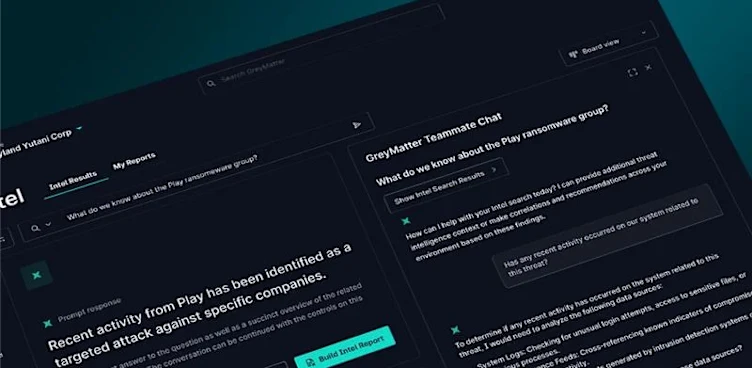
That is how we built GreyMatter. We launched it in 2018 and have built AI and agentic capabilities into it since 2023, turning it into what Frost calls “an AI-native security operations platform.” Humans lead, operate, and control the AI. GreyMatter multiplies what the team can do.
What Earned a Perfect Innovation Score
Frost places ReliaQuest among the vendors that “excel at innovation and can deploy highly advanced AI SOC platforms.” These vendors “use shared, customer-specific context to coordinate specialized AI agents across investigations, enabling the platform to adapt decisions to each organization rather than relying on generic automation.”
Here is what we believe drove the score.
1. A vendor-agnostic approach with portable normalization
Frost calls out “a highly effective vendor-agnostic approach that includes portable normalization.” GreyMatter’s Universal Translator automatically maps fields to OCSF. That makes detections, hunts, and investigations portable. Analysts also don’t need to know each vendor’s data format.
The result: Swap a tool without rebuilding your detections.
2. Detection without a proprietary data lake
Frost notes that GreyMatter “does not require a proprietary data lake or warehouse.” Teams can detect at the source through APIs. They can detect as data moves through GreyMatter Transit before indexing or storage, or against their existing SIEMs, lakes, and cloud stores. GreyMatter Transit analyzes telemetry while it moves from security tools to a SIEM, data lake, or storage system.
The result: Faster detection, and coverage without moving data first.
3. Six Agentic Teammates built on specialized agents
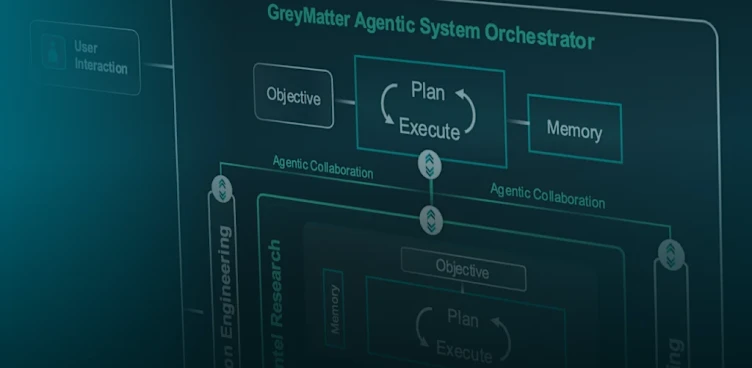
GreyMatter’s six Agentic Teammates cover incident response, detection engineering, threat hunting, threat intel, IT, and OT. Frost describes them as governing “hundreds of specialized agents and AI tools.” Each agent does one job.
The IR Teammate shows the depth. It analyzes every triggered alert and builds and revises investigation plans. It gathers customer-specific context, correlates evidence, and runs authorized containment in parallel across EDR, firewall, proxy, and identity systems. Then it writes the report and learns from feedback. GreyMatter uses more than 300 connectors that tap the full API surface of integrated tools, so it can see and act across endpoint, cloud, identity, network, email, SIEM, data stores, OT/IoT, SOAR, vulnerability management, and threat intelligence.
The result: Every alert investigated, and containment across the stack.
4. An AI Model Broker that picks the best model for every task
The AI Model Broker supports more than 25 models from providers including Azure/OpenAI, AWS Bedrock, Anthropic, and Google. It uses an LLM-as-judge framework to score models on cost, speed, and accuracy for each task. Proprietary security models, RAG, and knowledge graphs check and validate outputs. Agentic Memory keeps customer configurations, business context, and historical patterns. GreyMatter Chat routes plain-language requests to the right Teammate.
The result: Unlimited AI use at a flat price. Frost notes pricing “is endpoint based and allows unlimited AI usage,” with no token-, action-, or investigation-based charges.
5. Governance and transparency built in
Frost found that GreyMatter shows investigation steps, tools, findings, decisions, and actions. It also includes shadow mode, approval gates, Prompt Guard, crowdsourced QA, and expert validation.
The result: Customers decide what runs on its own and what needs a human sign-off.
6. A roadmap that reaches beyond the SOC
Frost highlights GreyMatter Attack, our red team Agentic Teammate, released in July 2026. It also cites our work on AI observability and misuse detection, and our planned Compliance/GRC Agentic Teammates.
The result: The same agentic workforce that defends the SOC will also test defenses, govern AI use, and support compliance.
How GreyMatter Maps to Frost’s AI SOC Best Practices
Frost lists three best practices for AI SOC providers. GreyMatter was built around each of them.
1. Go beyond alert triage to the full investigation. Frost says providers should extend to “evidence collection, investigation, root cause analysis, response, and case closure,” using customer-specific context. GreyMatter’s IR Teammate covers this full path, with Agentic Memory and live context from connected tools.
2. Keep human oversight and transparency. Frost says customers should control which workflows run on their own, require approval, or escalate. GreyMatter gives teams approval gates, shadow mode, and visible reasoning.
3. Integrate across the environment and prove results. Frost says providers should integrate across endpoint, identity, network, cloud, email, SaaS, threat intel, ticketing, IoT, and OT, and complement existing investments. GreyMatter works across 300+ connectors without a rip-and-replace.
What Defenders Get with GreyMatter
Frost’s analysis of ReliaQuest’s value proposition points to reduced complexity, increased MITRE coverage, lower alert noise, faster containment, and “moving customers from reactive to predictive operations.” Frost adds that this is “particularly attractive for customers with higher security maturity.”
Every customer receives a customer success manager and access to GreyMatter Engineers, who serve as architects and consultants to the defenders running the platform. Business reviews align platform activity with detection, response, efficiency, and maturity goals. Customer feedback drives quarterly product development, and ReliaQuest reports 94% customer retention.
Frost also describes ReliaQuest as “among the largest vendors in this Frost Radar™ analysis,” with more than 1,200 employees across six operating centers and one of the top revenue shares in the AI SOC market.
Frost’s verdict: GreyMatter pairs “product excellence and world-class third-party integration capabilities with managed expertise, unlimited-use pricing, enterprise expansion, and global expansion to deliver one of the most comprehensive AI SOC platforms in the market.”
Read the Frost Radar™
The Frost Radar™: AI Security Operations Centers, 2026 covers where the market stands, how 23 vendors compare, and what best practices buyers should expect.
Source: Frost & Sullivan, Frost Radar™: AI Security Operations Centers, 2026 (KC98-74), November 2026.