

A 138% surge in cyber intrusions signals a permanent shift in the threat landscape: high intrusion volume is the new normal. Overall intrusion volume has tripled throughout 2026, with 124 security intrusions observed in the last 90 days alone—a sharp jump from just 52 recorded in the prior period.
This volume is more than an isolated spike. It is the new operational standard for how attackers operate. Attackers favor identity-based tactics to blend in with legitimate user traffic, bypass perimeter controls, and accelerate lateral movement at a steady, high volume. Defenses built for occasional surges will not withstand continuous pressure, making it critical for security teams to adapt their security posture.
Here is a breakdown of the latest threat data, the playbook attackers are using, and the steps your team can take to defend:
By the Numbers: A Sharp Acceleration
Enterprise intrusion activity reached a new operational benchmark in 2026. The monthly average of intrusions has grown more than five times since 2024, from 4.0 a month to 21.0, signaling that threat actors have successfully turned initial access into a repeatable process.
Metric | 2024 | 2025 | 2026 |
Total Intrusions | 48 | 84 | 231 |
Monthly Average | 4.0 / month | 7.0 / month | 21.0 / month |
Organizations Affected | — | 70 | 183 |
In the last 90 days, October alone reached 61 intrusions while the prior monthly high was 23.
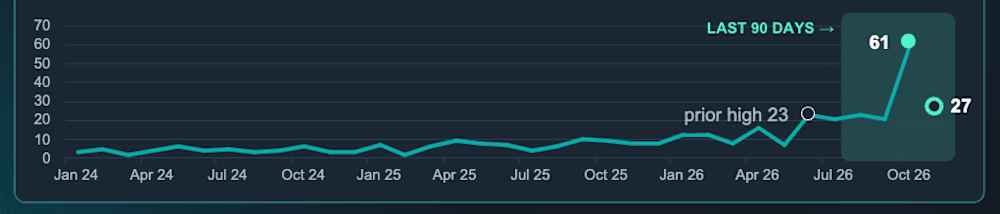
ShinyHunters-ecosystem intrusions reached 51, up 122% from 23 in the prior period. They accounted for 41% of all intrusions in the latest review. On October 29, the busiest single day, ReliaQuest raised 10 intrusions. Six were ShinyHunters MFA-persistence cases.
Examining the specific methods driving this surge shows how attackers scale these campaigns, and why understanding their playbook is critical for defenders.
Inside the Adversary Playbook
Adversaries are streamlining their attacks around human trust and identity controls. ReliaQuest tracked a heavy concentration of identity- and cloud-focused intrusion types from August to November.

Voice phishing and MFA account takeover, and edge and application exploitation, accounted for 61% of observed intrusions. Ransomware and hands-on intrusion fell by half. Attackers are picking quiet access and data theft over loud encryption.
A common sequence emerged across the intrusions we observed:
Fake IT call. The attacker poses as IT or help desk and builds urgency with an employee.
Fake SSO link. The employee is sent to a look-alike login page and enters credentials.
Own MFA added. The attacker registers a device they control to lock in access.
Bulk download. The attacker pulls data in bulk from cloud storage, SaaS apps, or file shares.
Extortion. The attacker threatens to leak the data unless the victim pays.
What Security Leaders Should Do Now
Siloed AI agents and static alert queues cannot keep up with intrusions that happen at a pace of more than 20 per month and rely on valid credentials. Defenders need Agentic Defense to close that gap, leveraging the same machine-speed tactics attackers are using while keeping their team in control.
To adapt to the increased intrusion volume, security leaders should prioritize the following actions:
Autonomous triage and correlation. AI agents connect alerts across identity, endpoint, and SaaS. A new MFA device followed by an unusual API query becomes one incident.
Machine-speed containment. Agentic workflows act in seconds—revoking sessions, suspending rogue MFA devices, and stopping bulk downloads before data leaves.
Continuous monitoring. Agentic systems continuously evaluate session behavior against a user's baseline to spot subtle warning signs in real time.
Elevating human defenders. Investigation and initial containment are offloaded to autonomous agents, so your security analysts can focus on threat hunting, hardening identity policies, and managing complex incident response.
How ReliaQuest Outpaces Intrusion Volume
It is a given that intrusion volume will keep rising as AI advances. Attackers are using agentic AI to move faster and operate at greater scale. Defenders need the same advantage, which is why ReliaQuest built GreyMatter.
GreyMatter is the agentic AI security operations platform that delivers Agentic Defense through Agentic Teammates. Powered by over 400 AI tools and 200 agent skills, these teammates break work into single-task agents to investigate every alert, proactively hunt threats, and execute responses across every core function of the SOC. Your team directs the work and sets the controls.
GreyMatter matches the attacker's speed. Over 1,300 of the world’s most trusted organizations using GreyMatter have seen:
3X output from their existing security team
Under 5 minutes to contain threats
Under 60 seconds to detect threats
99.4% AI accuracy
Rising intrusion volume is the new normal. Your defense should be built for it. With GreyMatter, your team does not have to choose between keeping up and staying in control.


