
Attackers have used AI to shrink the time from initial access to business impact to minutes. Defenders need to investigate on the same clock, but in most security operations, investigation time isn't spent on analysis. It's spent waiting on queries.
When an investigation depends on data that must be ingested and indexed in a SIEM first, mean time to investigate (MTTI) is 20–25 minutes. Roughly 80%–90% of that time goes toward searching. The reasoning is fast. The data access is slow.
GreyMatter SIEM-Less brings MTTI under 5 minutes by removing the points in the architecture where an investigation stops and waits. Here are the six pieces that make it possible.
1. Data Is Ready to Investigate the Moment the Alert Fires
In a traditional SIEM, data must be ingested, parsed, indexed, and stored before anything can run against it. Detections run as scheduled searches on top of that, so by the time an alert fires, the investigation is already working against a delayed copy of the data.
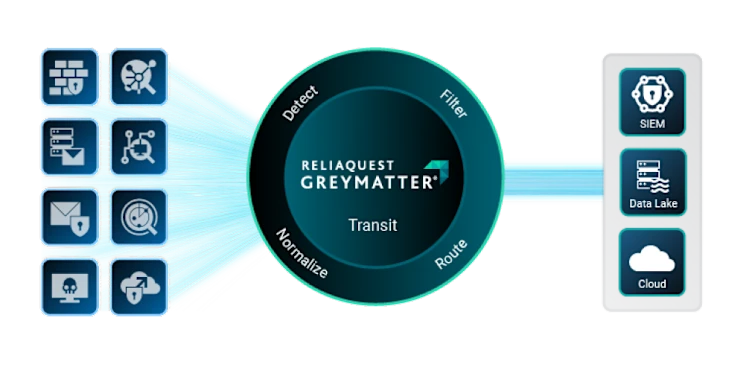
GreyMatter SIEM-Less flips that order. GreyMatter Transit parses raw logs, normalizes every event to OCSF, and runs single- and multi-event detections while the data is still in motion. Alerts fire in seconds. Transit writes the normalized data to the customer's own S3, Azure Blob, or Google Cloud Storage. GreyMatter Index (GMIX) picks up each new file and indexes it as it lands.
The alert and data needed to investigate it are ready together. The investigation never waits for storage to catch up.
2. Every Source Speaks One Language
Investigations are a series of questions. What else did this host do? Has this user signed in from this location before? Has this IP address appeared anywhere in the last 90 days?
In a multi-source environment, every source names the same thing differently. An IP address, a username, or a hostname lives in a different field depending on whether the event came from the endpoint, the identity provider, or the firewall.
Transit normalizes everything to OCSF in the pipeline, before it's written. Endpoint, identity, network, and cloud data all share one schema by the time they land in storage, so an investigation asks one question and gets one answer across every source. The data is normalized once, so no translation is needed at search time. It's stored as open Parquet in storage the customer owns, not in a proprietary format that only one tool can read.
3. GreyMatter Index Knows Where to Look Before It Searches
Scan-based query engines have no pre-built index, so every query reads through the dataset, or a large portion of it, to find matches. An investigation that runs several queries pays that cost every time.
GMIX does that work at write time. As Transit lands data in storage, GMIX builds an inverted index that maps every term to the exact events that contain it, including where each term appears, so even exact-phrase searches resolve from the index instead of a scan. Each search touches only the time range you ask about and goes straight to the matching events.
Because the data is stored as columnar Parquet, GMIX reads only the rows and fields a query needs, never whole files, and aggregations like totaling bytes in versus bytes out run against just the columns involved.
By the time GMIX reads anything, the index has ruled out roughly 99% of the data. Query time depends on how much the index rules out, not how much data you keep.
4. Search Never Waits Behind Detection
In a SIEM, detection is a search workload. Each hour, hundreds or thousands of scheduled searches run on the same infrastructure used to investigate. During an active incident, investigation queries compete with detection queries for the same capacity.
In GreyMatter SIEM-Less, detection runs in Transit, so the only searches GMIX ever runs are agent and human searches. Search compute isn't a pre-sized cluster that saturates under load. Lightweight watchers spawn short-lived search jobs on demand, and each one runs, returns its answer, and exits. ReliaQuest runs and scales that compute, so a busy day doesn't mean a slower investigation.
5. Live Context Comes Straight from the Source
Some questions are about what's happening right now. Is this host still talking to that IP? Is this user's session still active? Was the file already quarantined? GreyMatter answers them with federated search, sending each question through its direct connectors to the EDR, identity provider, or email gateway itself. The Universal Translator turns the question into that tool's native query language, and the answer comes back in seconds, without waiting for the data to be logged and queried separately.
Federated search isn't new to GreyMatter, but it matters more here: With storage no longer the bottleneck, live tool context keeps pace with everything else.
6. The Investigation Runs End to End Without a Handoff
Fast queries only matter if nothing else in the investigation slows down. The IR Analyst Teammate picks up every triggered alert as soon as it fires, including GreyMatter detections, custom rules, and native alerts from connected tools. It pulls live context from connected tools, queries historical data through GMIX, reasons through the evidence, and reaches a disposition at 99.4% accuracy, 24/7.
When the answer calls for action, there's no handoff to another console. Because the stored data stays connected to GreyMatter, the same platform that finds the answer can block the IP address, ban the hash, or contain the host.
Putting It Together: Where the Minutes Go
At-Storage Investigation | GreyMatter SIEM-Less | |
|---|---|---|
Data ready to query | After ingestion, parsing, and indexing | As it lands, already normalized |
Querying across sources | Translated at search time | Normalized once to OCSF, so no translation is needed at search time |
Query execution | Scan-based | Index-pruned, targeted reads |
Search capacity | Fixed, shared with scheduled detections | Used only for investigations, scales on demand |
Mean time to investigate | 20–25 minutes | Under 5 minutes |
None of these pieces are dramatic on their own. Together, they remove nearly every point where an investigation used to stop and wait.
Investigate and Respond with GreyMatter SIEM-Less
GreyMatter SIEM-Less gives you the benefits of a SIEM without the tradeoffs. Transit detects threats in motion, GreyMatter Index makes stored data fast to search, and the data stays in your own object storage in an open format you control. ReliaQuest runs and scales the compute and never charges per query.
What Changes When the Wait Is Gone
Investigation timelines have always been set by architecture. GreyMatter SIEM-Less removes the architectural bottlenecks that define them: data ready the moment an alert fires, one OCSF schema across every source, an index that narrows before it reads, and search capacity dedicated to investigations. Paired with federated search into connected tools and an IR Analyst Teammate that carries the investigation through to response, SIEM-Less brings MTTI from 20–25 minutes to under 5 minutes.