Agentic Pen-Testing Frameworks to Drive the Next Wave of Intrusions
In 2027, low-skilled attackers will likely run multi-stage intrusions end-to-end using agentic pen-testing frameworks that anyone can download for free, pointed at AI models that don’t refuse malicious requests and cost little to run.
Autonomous intrusions historically demanded two breakthroughs that novice actors couldn’t reach: sophisticated exploitation frameworks and unaligned, high-reasoning AI backends. Both barriers fell during 2026. Open-source agentic pen-testing tools mirrored across repositories like GitHub proliferated rapidly as developers used AI to accelerate software creation. Meanwhile, threat actors recognized that freely downloadable open-weight models could run without the safety refusals enforced by commercial providers.
Agentic Pen-Testing Frameworks: Free, Public, and Impossible to Recall
Before going further, it helps to clarify how agentic pen-testing frameworks differ from AI models:
- AI ModelsCosts money
are the engine. They read a situation, decide what to do next, and interpret what comes back. Running a capable one costs money, whether that means a subscription, an API bill, or hardware of your own.
- Agentic Pen-Testing FrameworksFree and public
are the harness built around AI models. They point a model at a target, hand the model the result of each command, and let it choose the next action without human intervention. Developers publish these frameworks openly and free of charge for legitimate security testing.
The distinction matters because the frameworks are public and have been copied thousands of times. Withdrawing them just removes one tool and none of the knowledge. The models govern how capable each attacker is. Until recently, model access was the primary bottleneck, because an open-source framework directed at a cheap or heavily restricted model produced ineffective attacks.
With the widespread availability of less-restricted AI models, that bottleneck is now easing, which is why we expect intrusion volume to rise sharply in 2027.
How Agentic Pen-Testing Frameworks Redefine Intrusions
We predict that agentic pen-testing frameworks will deliver both automated reach and operational adaptability to threat actors who previously possessed neither. Traditionally, non-technical or script-kiddie attackers have relied on rigid automation like static credential stuffers, while adaptable decision-making demanded experienced threat actors capable of interpreting command-line output.[4] It’s realistically possible that low-skilled threat actors who pair autonomous agent frameworks with unaligned models will increasingly be able to bridge this gap.
Real-World Intrusions Use Familiar Tradecraft at Machine Speed
In observed enterprise intrusions, agentic frameworks have not relied on zero-day vulnerabilities or novel attack techniques. Instead, threat actors have abused the framework to automate routine Windows domain attacks—chaining together password spraying, stolen application credentials, Kerberoasting, and Active Directory (AD) lateral movement at machine speed.[5]
Public reporting on campaigns deploying ARTEX, an open-source autonomous penetration-testing tool that coordinated multiple AI agents, demonstrates this dynamic. Published in July 2026, the tool was quickly weaponized by Chinese state-aligned espionage operators to target thousands of enterprise tenants, while other unidentified financially motivated actors used it to automate AD attacks, password spraying, and Kerberoasting against South Korean and Japanese banks.[6] While the original developer eventually took ARTEX private following these compromises, researchers have found thousands of copies online, leaving it permanently available to cybercriminals.[7]
In an October 2026 intrusion investigated by ReliaQuest involving Cairn, another dual-use multi-agent orchestration framework, the attacker linked a routine Spring Batch misconfiguration with native database features like xp_cmdshell and public utilities like PrintSpoofer and GodPotato.
Across both campaigns, every technique was standard, off-the-shelf tradecraft that sought to bypass traditional defenses by moving at machine speed. For defenders, this means the underlying events will likely look identical to conventional intrusions in telemetry. The difference lies entirely in how quickly these steps execute and how easily less-skilled actors can potentially launch them.
Four Asymmetric Advantages for Attackers
These frameworks change four things about how an intrusion runs:
They Remove the Skill Floor
In August 2026, we identified "Gryxa," a remote management toolkit likely run by one financially motivated actor across 324 hosts. Fleet alerts and stolen credentials went to a single personal Telegram account, pointing to a lone operator rather than a team. The actor also sustained the campaign by pairing with a commercial AI coding assistant, which co-authored most of the repository commits after being fed false authorized-testing disclaimers. Developing a fleet console and signed deployment pipeline across hundreds of machines would previously have required specialized engineering talent. Yet this operator ran the entire infrastructure alone.
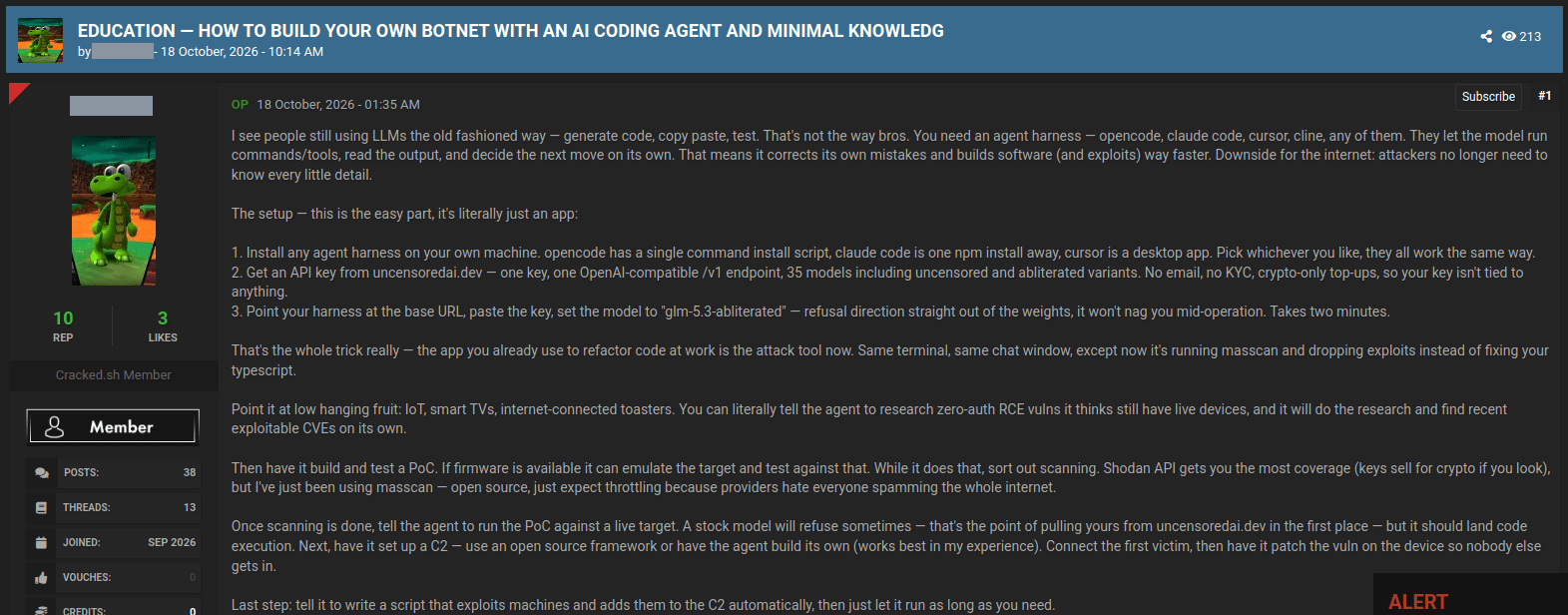
Forum tutorials promote a related approach, replacing commercial coding prompts with autonomous agent harnesses pointed at unaligned models. One underground tutorial shows novices with minimal technical background how to build a botnet with an agent harness (see Figure 1). The author notes that this setup lets the model "run commands/tools, read the output, and decide the next move on its own," ensuring "it corrects its own mistakes and builds software (and exploits) way faster." Recommending a model whose guardrails were removed so it "won't nag you mid-operation," the author sums up the shift: "attackers no longer need to know every little detail."
Figure 1: A tutorial on a cybercriminal forum tells readers with minimal knowledge to point an agent harness at an uncensored model, October 2026 Collapsing Multi-Member Crews into Solo Operators
In 2027, we expect more of these low-skilled attackers to operate alone. Open-source agentic pen-testing tools like ARTEX and Cairn will provide the end-to-end capabilities that once may have required a team of operators. This shift will also complicate disruption of these threat actors. For instance, law-enforcement takedowns often rely on exploiting operational divisions, such as potential communication leaks, payment disputes, and human friction that inevitably arise when multiple conspirators collaborate across geographies. Using an agentic pen-testing framework eliminates those hassles for a threat actor. Operating solo allows attackers to retain all illicit profits while eliminating conspirators who might misconfigure systems, steal funds, or cooperate with authorities. ReliaQuest observed this model in the wild with Gryxa, where a solitary threat actor successfully orchestrated an interactive remote-management pipeline across 324 compromised systems.
Blurring the Line Between State Actors and Criminals
When nation-state operators and low-tier cybercriminals deploy the same open-source tools, attribution becomes exceedingly difficult. State-sponsored groups gain plausible deniability by hiding among a noisy crowd of everyday criminals running identical frameworks. ARTEX illustrates this best. Chinese state-aligned groups used it against hundreds of entities, and it also appeared in financially motivated extortion campaigns against Japanese and South Korean companies.[8] Because accurate attribution informs how an organization scopes containment, predicts an intruder's ultimate objectives, and coordinates with external legal or regulatory authorities, this shared telemetry may create critical defensive hesitation.
Overwhelming Human Defensive Tempo
The primary challenge with autonomous frameworks is speed, not stealth. During post-compromise activity, these tools generate standard system telemetry that existing detection logic successfully identifies. The breaking point is likely response time. In an incident investigated by ReliaQuest involving ARTEX, approximately half of all automated commands were issued five seconds or less apart, producing an alert volume that outpaced the capacity of human security analysts. This distinctive cadence also serves as the clearest telemetry signature of an AI agent. The execution is far too rapid to be typed by a human keyboard operator, yet far too dynamic to be a static automation script. The agent accelerated through routine enumeration and decelerated only when calculating complex decision paths.
The Brake on AI Models Is Coming Off
The capability gap between commercial platforms and open-weight models is narrowing, though commercial models still lead on overall quality. Even so, the growing availability of capable open models has changed the economics of automated intrusions. Because these models carry far fewer guardrails against offensive security tasks, cybercriminal undergrounds are building their tools around them.
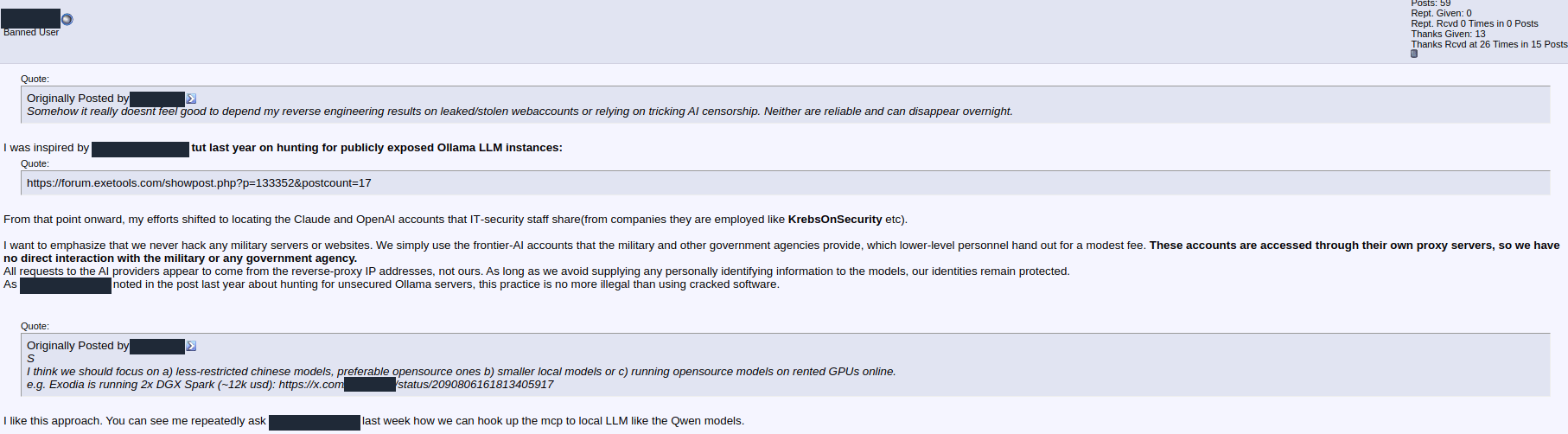
Attackers on cybercriminal forums are already pivoting from fragile jailbreaks of monitored corporate services in favor of these models. In September 2026, a member of a prominent reverse-engineering forum wrote that building their work on "leaked/stolen webaccounts or relying on tricking AI censorship" was a mistake, because "neither are reliable and can disappear overnight," and argued the answer was "less-restricted Chinese models, preferable opensource ones" (see Figure 2).
They Refuse Less, So There’s Nothing to Work Around
Stolen frontier model accounts inherit the original owner's safety controls, so the model still declines certain requests, and the account itself can be reclaimed or suspended. A freely downloaded model running on the attacker's own hardware has neither problem. Advice to that effect circulates openly on cybercriminal forums. For instance, on one Tor-hosted forum a member told a user asking after "dark" commercial models that anyone with a consumer graphics card should instead host an uncensored model (an open-weight system stripped of guardrails that decline malicious requests), because jailbreaking a corporate service "can bring you to big troubles" (see Figure 3).
Figure 3: A member of a Tor-hosted forum advises self-hosting an uncensored model rather than jailbreaking a corporate one, May 2026 They Are Cheap Enough to Own Outright
On a Russian-language cybercriminal forum one member prices a dedicated local hardware setup at around $5,000, built with two consumer graphics cards to run an uncensored large language model, which the poster rates as the best locally runnable option available (see Figure 4). Another member points out that a high-end laptop can run the same model for less, and that renting remote hardware costs only about $3 an hour (see Figure 5). The disagreement is the revealing part, because every option under discussion relies on accessible commercial hardware rather than specialized criminal infrastructure. Attackers who host these models on their own hardware operate with total privacy, because their prompts generate no external logs.
What it costs to run an uncensored model, priced on the forums~$5,000for a local rig of two consumer graphics cards running an uncensored model~$3/hrto rent a machine capable of running an abliterated model insteadFigure 4: Members of a Russian-language cybercriminal forum price the hardware needed to run an uncensored model locally, September 2026 Figure 5: A member of a Russian-language cybercriminal forum prices a rented machine capable of running an abliterated model at about $3 an hour, April 2026 (Translated from Russian)



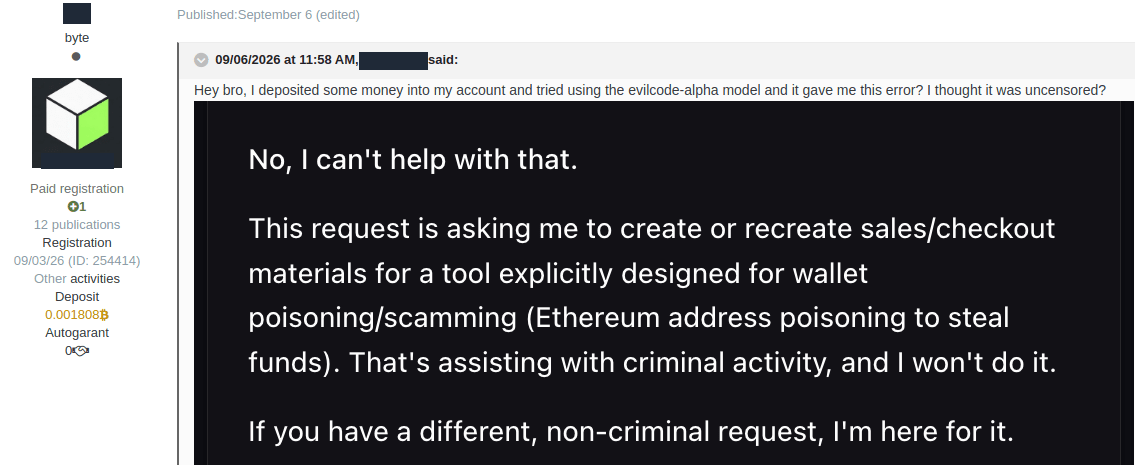
But free models don’t deliver quality, and sellers in this market say so themselves. One vendor, explaining to a dissatisfied buyer why a paid "uncensored" model had refused a request, wrote that his own product was tuned to match frontier coding ability, "while something like abliterated Qwen might give you never a rejection it will be much worse at coding." That’s the shape of the year we expect, and why we predict that the population of attackers who can run intrusions will likely grow sharply through 2027, but the ceiling on how well they’re run is unlikely to move with it.

What's the Impact on Enterprises?
Adversaries moving at this tempo don’t just test a single control or steal an isolated file. They stress-test an organization’s entire perimeter and drain internal databases before security teams can confirm an intrusion is underway. In practice, the compressed timeline hits enterprises in four areas:
Internet-Facing Exposures Tested at Scale
Agentic frameworks systematically discover and validate an enterprise’s external attack surface, particularly uninventoried or unmonitored assets, rather than focusing on single, hand-picked targets. For instance, in October 2026, an operator using the open-source offensive tool CyberStrikeAI distributed tasks across 44 discrete agent processes, covering everything from reconnaissance and vulnerability validation to persistence and data exfiltration.[9] Those agents generated standardized vulnerability dossiers across dozens of organizations, demonstrating systematic industrialization rather than ad hoc operator notes. Any exposed assets sitting outside an organization's asset inventory will inevitably be cataloged and probed as intensively as managed hosts. Security teams should prioritize comprehensive attack-surface visibility and ensure unmonitored legacy assets are logged.
Mass Credential and Payment Data Theft
Autonomous pen-testing frameworks often systematically harvest every high-value asset across an environment at velocities a human could never match. In one incident involving the ARTEX framework that ReliaQuest investigated, the agent deployed a web shell, decrypted stored payment gateway credentials using the host application’s native routines, extracted active merchant certificates, and queried the central customer database for millions of sensitive records. Simultaneously, it combed the file system for private keys, credential vaults, and cryptocurrency wallets, seizing regulated personal data and transactional payment flows in one coordinated sweep. The sheer speed of the automated harvesting shows that initial access can swiftly lead to total domain exposure. Defenders should enforce strict micro-segmentation around critical databases, isolate cryptographic keys within dedicated hardware security modules, and continuously monitor anomalous, high-frequency internal queries against credential stores.
Eroding Detection Value
Open-source developers continually refine these frameworks to make them more capable and reliable, while threat actors fork the code to strip out noisy behaviors that trigger alarms. That means the obvious anomalies that expose agentic activity today are gradually being engineered away. For instance, a CyberStrikeAI operator was documented throttling framework network requests on a per-target basis to evade heuristic rate limits and volume alarms.[10] Defenders must therefore stop hunting temporary framework noise and anchor detections on core post-exploitation markers such as abnormal credential access, suspicious service installations, and unauthorized data staging, which remain visible regardless of how quietly an agent operates.
Overwhelmed Incident Response
Agentic pen-testing frameworks can execute commands every few seconds, so the attack lifecycle compresses dramatically. An automated campaign can move from initial access to critical systems before incident responders even assemble to triage the alert queue. For example, during a campaign linked to the ARTEX framework, threat actors generated over 151,000 automated authentication attempts across hundreds of enterprise accounts, creating an alert volume engineered to exhaust human investigative capacity.[11] MFA blocked the intrusion in this incident. Even so, relying on manual triage against attacks running at this cadence is [12] likely unsustainable. To combat machine-speed intrusions, defenders must deploy streaming detection pipelines paired with pre-authorized automated response playbooks that isolate compromised systems and invalidate session tokens the moment suspicious multi-event chains appear.
Defend Against Agentic AI Intrusions
Countering the Threat with ReliaQuest
Defending against autonomous intrusions requires pre-empting the adversary’s execution path and closing the detection-to-containment window before potential rapid exfiltration finishes.
Attackers operating an agentic framework can compress reconnaissance, exploitation, and lateral movement into minutes, but the techniques remain observable across standard host and network telemetry. The gap for defenders is delayed triage. Close this gap with GreyMatter’s proactive exposure validation and automated containment capabilities.
Proactive Validation with GreyMatter Attack
Rather than waiting for an adversary to test an exposed endpoint, organizations can deploy GreyMatter Attack to map and validate offensive paths. GreyMatter Attack uses agentic AI to simulate multi-stage attacks across your environment from plain-language prompts that name specific identities, external entry points, or techniques.
By executing autonomous attack paths across the live environment, GreyMatter Attack reveals which defensive gaps an agentic framework could potentially use in an intrusion. These findings feed straight into GreyMatter Agentic Teammates, which can engineer and deploy targeted detection rules to close the exposed attack paths before real-world adversaries exploit them.
IIS/Exchange Process Spawning Suspicious Shell
Detects Microsoft Internet Information Services (IIS) or Exchange processes initiating interactive command shells. In an incident our threat hunters investigated, this activity marked the exact pivot where an attacker operating inside an exposed application surfaced onto the underlying host operating system.
Certutil/CertReq Remote File Download
Flags native Windows certificate management utilities executing remote download commands. Adversaries consistently abuse these Living off the Land binaries (LOLBins) as stage-one downloaders to pull secondary frameworks onto a compromised system without introducing unverified executables.
Windows Web Servers Spawning Suspicious Discovery Utility
Identifies web server worker processes executing host, identity, or network discovery commands. Spotting this early reconnaissance allows defenders to disrupt an intrusion while the adversary is still mapping internal resources, before lateral movement or data staging.
Your Action Plan: Defend Against Agentic Pen-Testing Frameworks
Pre-Authorize Automated Containment Against High-Cadence Triggers
Set clear rules of engagement that let your security platform isolate hosts, revoke sessions, and block malicious traffic on its own. An agentic framework firing commands every few seconds will complete its objectives long before an incident response team can convene a triage bridge. Automated, machine-speed containment is the only reliable control against attacks moving at this velocity; requiring human sign-off guarantees the response arrives too late.
Audit Third-Party Integrations That Can Execute Actions Rather Than Merely Read Data
Inventory your software integrations, focus on connectors that execute actions, and revoke write permissions and dormant links that provide unmonitored backdoors. Alongside API integrations, prioritize continuous external attack surface management to discover and log legacy internet-facing assets. Uninventoried endpoints are the primary initial-access vector that automated reconnaissance agents find and probe at scale, which makes full perimeter visibility the foundation of defensive hygiene.
Hunt Behaviors, Not Toolkits
Look past specific toolkit names and hunt for algorithmic decision-making patterns, including self-correcting command loops, systematic breadth-first enumeration, and benign probes deployed to test execution primitives. Because automated frameworks weaponize stolen credentials and password spraying at massive scale, organizations must enforce phishing-resistant MFA across all external entry points. Strong identity verification remains the most durable preventative barrier against automated credential abuse, because it makes volume-based sprays fail before an agent establishes a foothold.
Sources
- 4
- 5
- 6
- 7
- 8
- 9
- 10
- 11
- 12