Spotting that pattern early is important — it changes what defenders should expect next, for example more variants of the same lure, faster infrastructure rotation, and code that looks clean but is often shallow underneath.
What's also important to remember here is that these indicators are useful, but they won't last forever. As awareness of AI fingerprints spreads, attackers will almost certainly start to clean them up, particularly the easy-to-fix ones like Markdown residue, curly quotes, and overexplained comments. The contextual and operational signals (infrastructure cadence, payload clustering) are the ones that are more likely to hold up as they're harder to hide.
Vocabulary Fingerprints
LLMs tend to draw from a narrower vocabulary band than they first appear to, especially in polished or formal writing. For years, awareness training taught users to look for bad grammar and awkward phrasing, but AI has now weakened that guidance. In many cases now, the more suspicious lure is the one that sounds too polished.
Common examples include:
- Corporate or sales language: "leverage," "empower," "facilitate," "seamless," "robust," "elevate," "revolutionize," "harness," "showcase," "underscore," "pivotal," "garner."
- Overwritten literary language: "delve," "tapestry," "intricate," "meticulous," "vibrant," "bolstered," "testament," "landscape," "crucial."
- Generic connective phrasing: "align with," "fostering," "enhance," "contributing to."
Tell-tale AI Vocabulary Fingerprints
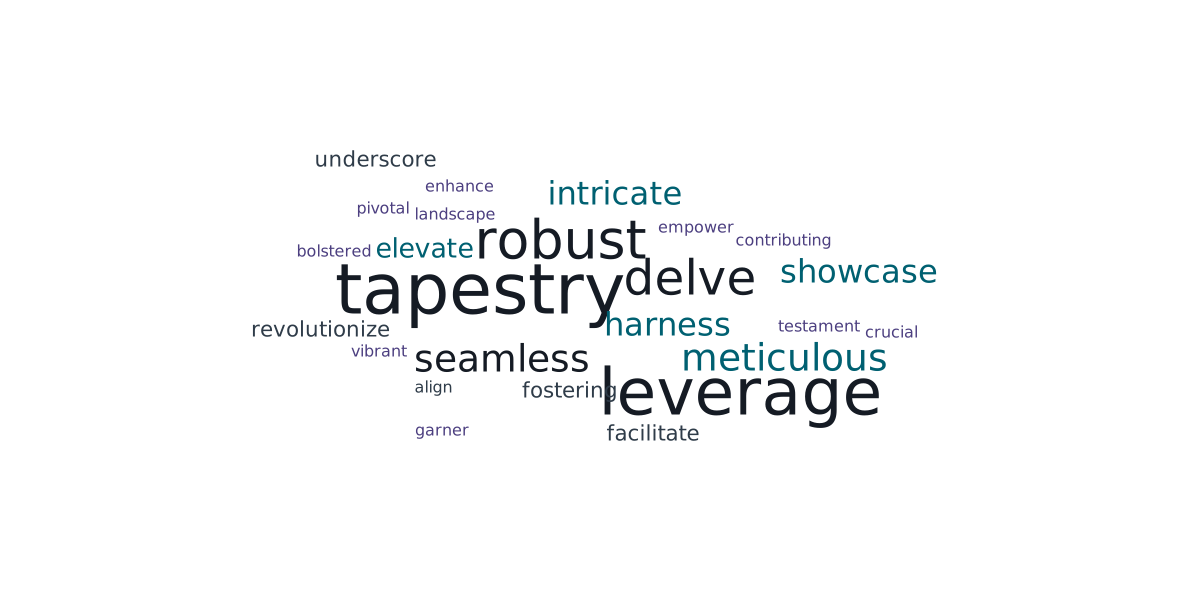
No single word is suspicious on its own. The signal comes when several appear together in text that should be short, direct, and functional, such as a ransom note, a help-desk script, or a fake job description. LLMs default to fluency and completeness, so they often produce language that sounds more polished than the context calls for.
Structural Fingerprints
Beyond word choice, AI also has structural habits that show up across different types of content. These structural tells are useful in triage because they're fast to spot and often suggest a workflow built for reuse. When defenders see them, they should assume the artifact may be one of many easy-to-generate variants and widen the investigation beyond exact matches, looking for the same logic, layout, or behavior across related files, pages, or payloads.
Common patterns include:
- Uniform sentence length with fewer short, blunt sentences and less natural variation.
- Little or no first person even where it would feel natural.
- Formulaic bullet structure, especially bold inline header + colon + explanation
- Parallel phrasing that repeats sentence structure, such as "This function does X. It is responsible for Y. It then performs Z."
- Heavy reliance on em-dashes and colons in repetitive sentence structures.
We saw this clearly in one of the web shells discussed earlier. The comments were neatly formatted, highly uniform, and explanatory in places where a human operator likely wouldn't have bothered commenting at all.
Formatting and Typography Fingerprints
Some of the clearest tells come from output that still carries traces of the LLM interface itself. These are often stronger indicators because rather than being purely stylistic, they're often the residue of AI-generated content being copied directly into a payload, script, or lure with little cleanup.
Common examples include:
- Curly quotes in code or commands instead of straight quotes (
"vs"). - Stray Markdown such as fenced code blocks, horizontal rules, or bold syntax left in plain text.
- Emojis in comments or prompts, especially in code or scripts.
- Excessive commenting in very short or simple code.
Code-Specific Fingerprints
AI-generated code tends to have a recognizable imbalance between what it overdoes and what it neglects. Security teams should be aware of these patterns, because clean formatting, heavy commenting, and polished structure used to suggest a more disciplined or capable operator. Now, they can just as easily point to AI-assisted code generation. These are also useful in forensic analysis, where artifacts left behind in scripts, payloads, or supporting files can help analysts assess how the code was produced and whether AI likely played a role.
What AI Often Overdoes
- Comments that explain what the code is doing instead of why.
- Extra helper functions where one function would do.
- Overly uniform formatting and comment style.
- Placeholder text left behind, such as
YOUR_API_KEY_HERE,# TODO, or<insert value here>.
What AI Often Underdoes
- Modular structure and separation of concerns, with too much logic crammed into a single file.
- Project context, including dependency handling and supporting files (e.g.,
.gitignoreand README conventions). - Consistent naming conventions.
- Import accuracy, including hallucinated libraries or functions
Hallucinated imports are especially useful for defenders, because if code references a library or function that doesn't exist, that's one of the stronger single indicators of AI generation. It also creates a detection opportunity, as AI-generated malware can fail in real environments because of these fingerprints in ways defenders can catch.
Contextual and Operational Fingerprints
Some tells only become visible when defenders look across an entire campaign rather than a single artifact. These signals tend to carry more weight. An operator can remove Markdown residue or rewrite a few phrases, but it's much harder to hide 40 near-identical payloads appearing in a tight time window or hundreds of branded subdomains following the same pattern.
They're also harder for organizations to spot. Finding them requires visibility across multiple parts of the environment and the ability to connect those signals, which many teams still lack. Teams that can correlate across those views will keep identifying AI-augmented activity even after the more obvious clues are cleaned up. Teams that can't will be slower to detect and respond, which is exactly the advantage these attacks are designed to create.
As surface tells disappear, these contextual and operational patterns should remain useful longer because they're harder to clean up without changing the workflow itself.
Common examples include:
- Language mismatches, such as polished lure content in one language and debug or backend content in another (like in the mass phishing campaign we covered earlier).
- Default LLM leakage, including apology text ("I cannot assist with that"), refusal fragments, or copied prompt scaffolding ("Certainly! Here is the script you requested…").
- Similar payloads deployed across victims in near-identical time windows.
- Domain templates, subdomains, or pages spun up at a cadence that suggests automation.
- Uniform infrastructure names that look generated rather than chosen manually.
- Mixed-signal artifacts, where sophisticated infrastructure sits alongside obvious AI residue or beginner-level mistakes.
The last category is especially useful. A production-grade phishing kit with leaked LLM boilerplate or sloppy AI residue can tell defenders as much as any individual clue on the page.