Skip to Content

Turning One Environment’s Threat Signal into Network-Wide Immunity

Threat actors like Scattered Spider operate on compressed timelines. They exploit SaaS and identity systems to harvest credentials and secrets, then use legitimate access to move laterally, allowing them to complete campaigns in hours instead of days.

For most SOCs, this creates an impossible gap. Tool-by-tool investigation, delayed threat intelligence, and reactive detection engineering means defenders are responding after access has already been established.

The challenge is no longer just seeing threats as they happen. It’s about anticipating them—getting ahead of attackers in time to prevent their impact.

Cybersecurity is a team sport. The more we collect and distribute intelligence, the more we can prepare for threats, and the better protected we all are.

We’ve built that principle into the GreyMatter agentic AI security operations platform.

This guide walks through a specific use case: How the GreyMatter “network effect” defended customers against Scattered Spider activity in 2025—turning early signals into proactive, predictive defense across our customer base while tailoring controls to each environment.

Video

How the GreyMatter Network Effect

Revealed the Attacker's Next Target

<h3><b>700,000+ Domain </b>and Subdomain Alerts Analyzed</h3><h3></h3><p></p>

700,000+ Domain and Subdomain Alerts Analyzed

Early warning and automated protection delivered before mainstream awareness.

<h3><b>7 Detection Rules Deployed in Days Across All Customers</b></h3><p></p>

7 Detection Rules Deployed in Days Across All Customers

Accelerated defense transformed isolated research into instant, network-wide immunity.

<h3><b>Over 40 Impersonation Domains Neutralized</b></h3><p></p>

Over 40 Impersonation Domains Neutralized

GreyMatter DRP identified and blocked new supply-chain threats targeting identity and ticketing systems before credential compromise.

<h3><b>Predicted Salesforce and Zendesk Targeting Before Attacks Escalated</b></h3><p></p>

Predicted Salesforce and Zendesk Targeting Before Attacks Escalated

Customers hardened defenses in advance across their security tool stack, reducing risk of data loss and business disruption.

<h3><b>Agentic Teammates</b> <b>Executed Targeted Threat Hunts And Rapid Response Actions</b> </h3><p></p>

Agentic Teammates Executed Targeted Threat Hunts And Rapid Response Actions

across diverse customer environments without manual integration or platform-specific tuning.

The Shift from Reactive to Predictive Defense

Traditional security workflows operate in isolation. Each organization investigates threats within its own environment and intelligence using disparate tools, following defined processes and investigation procedures, and with no visibility in communication with other organizations facing the same threats. That model breaks at scale.

The GreyMatter network effect expands the investigation plane by connecting isolated insights into collective intelligence. This enables organizations to:

  • Identify Early Indicators of threat actor activity visible across multiple customer environments simultaneously, not just within your own data.

  • Recognize patterns across global threat intel and unified telemetry not isolated alerts within a single organization.

  • Convert Those Patterns Into Detection Logic with automated response workflows—then immediately share and deploy them across the network.

  • Protect Automatically And Before Exploitation turning one customer's detection into every customer's immunity.

GreyMatter enables this shift by combining collective threat intelligence, cyber asset attack surface management, digital risk protection, and the GreyMatter Agentic Teammates—a group of collaborative, role-based agentic AI personas—into a single operational model.

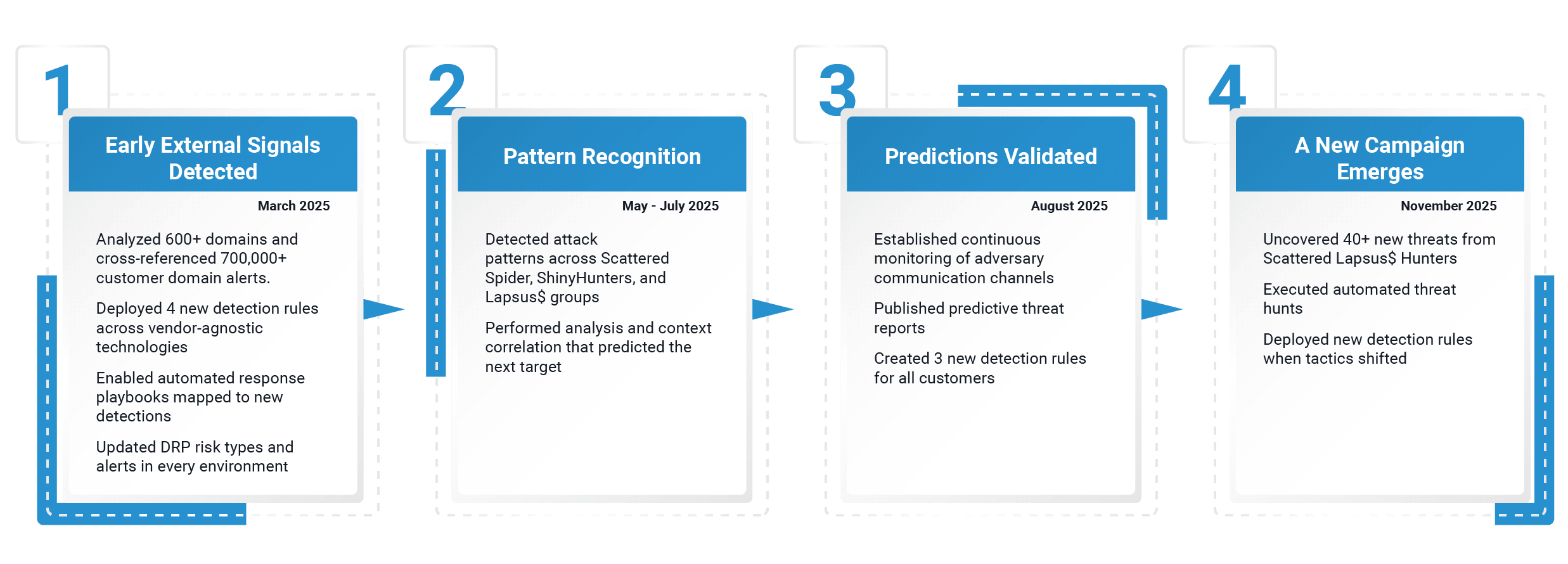
How GreyMatter Outpaced Scattered Spider: A 2025 Timeline

Predicting Scattered Spider | Image | 2025 Timeline

March 2025: Early External Signals Detected

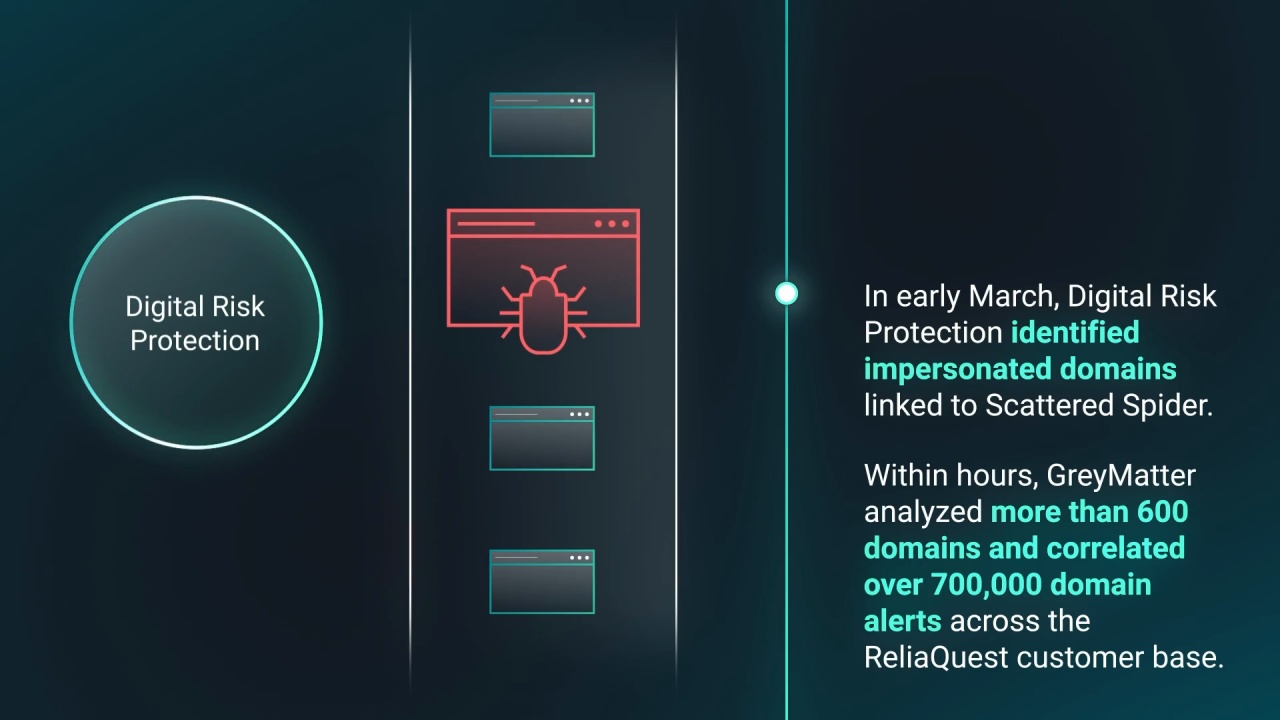
GreyMatter identified suspicious domain activity and impersonation patterns, automatically launching hunts and cross-referencing hundreds of thousands of alerts. Within hours, new detection rules and response actions were deployed across all customer environments.

May–July 2025: Pattern Recognition

GreyMatter correlated domain patterns and infrastructure overlaps revealing coordinated attacker activity. This predicted the next targets through analysis of external threat intelligence and internal telemetry.

August 2025: Predictions Confirmed, Intel Applied

Before threat group activity escalated, GreyMatter delivered predictive intelligence and deployed tailored detection rules and proactive defense for every customer.

November 2025: A New Campaign Emerges

GreyMatter identified a new wave of SaaS impersonation and credential attacks, executing targeted hunts and deploying new protections to all customers before the campaign gained public awareness.

Continuous Protection

Throughout 2025, GreyMatter continually evolved its detection logic and automated response playbooks—transforming single threat signals into shared, adaptive defense for every customer.

How the GreyMatter Network Effect Benefits Your SOC

  • Collective Intelligence, Shared Defense: GreyMatter’s technical architecture transforms one customer’s threat visibility into shared defense—automatically. The platform’s Universal Translator normalizes telemetry and threat data from thousands of sources, while GreyMatter Agentic Teammates synthesize findings and recommend proactive actions across environments.

  • Protection Before Mainstream Awareness: When GreyMatter detects a new domain or attack pattern, it pushes tailored detection rules and DRP protections to every customer. This means organizations are protected before threats hit the headlines—turning threat research into network-wide automated defense.

  • Tailored Defenses for Every Environment: Whether you’re in finance, retail, technology, GreyMatter adapts to your unique technology stack. Agentic Teammates scale your teams expertise to conduct intel research, tune detection logic, and recommend playbooks based on your unique risk profile, technology footprint, and sector trends.


In the Scattered Spider case: Customers were defended against Salesforce targeting eight weeks before public disclosure. They didn't react to industry alerts. They were already protected.