
What is a Multi-Agent System?
Definition of a Multi-Agent System
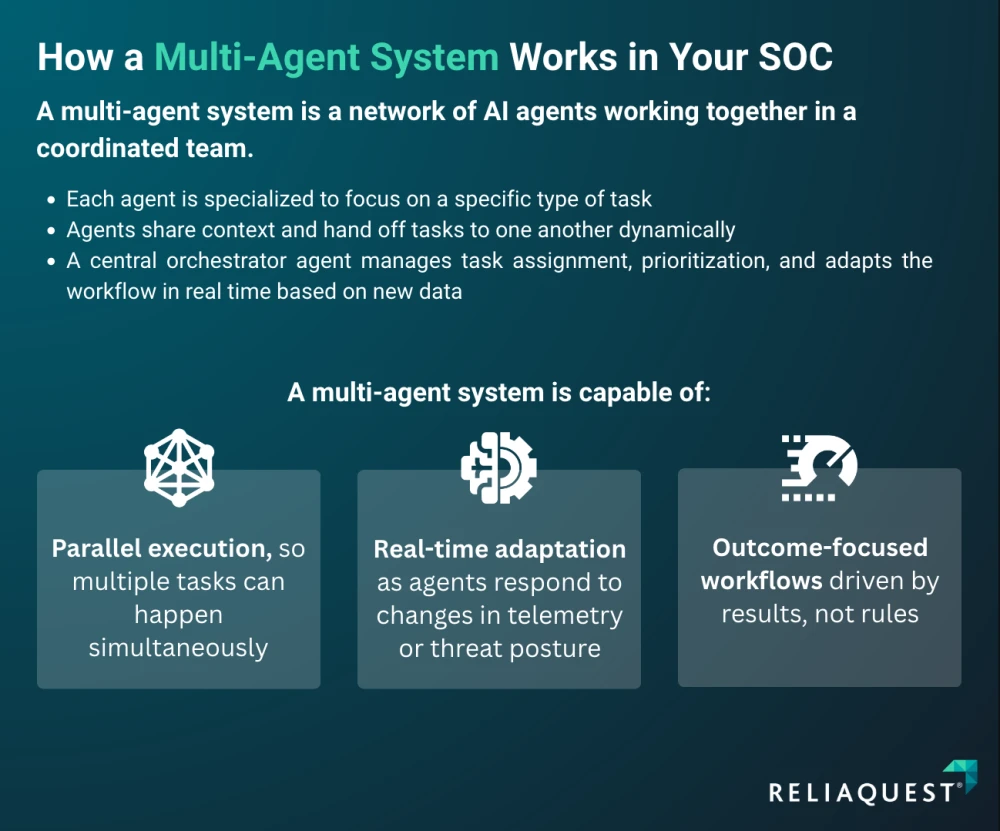
A multi-agent system (MAS) - also known as a super agent - is a network of autonomous artificial intelligence (AI) agents that work collaboratively to achieve a common goal. Each agent within an MAS has its own specialized properties and decision-making capabilities, but collectively they coordinate to produce desired global outcomes.
They are designed to solve large-scale, multi-step, complex problems that would be inefficient or impossible for a single agent or human team.
How Do Multi-Agent Systems Work?
Multi-agent systems complete complex tasks by assigning tasks to different AI agents, each capable of autonomous reasoning, planning, and adapting to new information. Autonomous agents interact through orchestration, exchanging information, coordinating workflows, problem-solving, and ensuring their actions align with system-wide objectives.
Key aspects include:
Autonomy: Each agent independently performs specialized tasks.
Collaboration: Agents share information and coordinate decisions.
Adaptability: The system adjusts dynamically as conditions or inputs change.
Tool Integration: Intelligent agents access APIs, external data, and services to fill knowledge gaps.
Orchestration: A supervisory agent or mechanism ensures agents remain aligned with global goals.
Unlike traditional automation, which follows rigid workflows, MAS are dynamic, modular, and outcome-driven, enabling parallel execution and real-time responsiveness.
What is an AI Agent?
Multi-agent systems are made up of individual autonomous AI agents. Each agent operates with a clearly defined role or objective, such as summarizing, correlating, or enriching data. To do this effectively, it draws on relevant data sources, including telemetry, threat intelligence, or historical alerts.
As they are equipped with decision-making capabilities - based on rules, heuristics, or embedded models - agents can evaluate incoming information and decide on the most appropriate action. Crucially, they’re not passive: they can take action within their environment.
In agentic AI workflows, these agents don’t just respond to prompts; they can plan, reason, adapt, and execute actions. When multiple agents collaborate, they create a system that is more accurate, scalable, and resilient than any one agent acting alone.
What is Agentic AI?
Agentic AI is the broader framework that enables AI agents to act with autonomy. While generative AI focuses on producing text or summaries, agentic AI gives systems the ability to take initiative, make decisions, and execute actions within their environment. It’s the foundation that allows multiple agents to collaborate effectively, forming coordinated multi-agent systems capable of handling complex, real-world tasks at scale.
What is an AI Orchestrator Agent?
An AI orchestrator agent facilitates agent collaboration. It is the coordinating agent within a multi-agent system that directs and synchronizes specialized agents. It functions as the decision-making hub, ensuring that complex workflows remain efficient, aligned, and transparent.
Its key responsibilities include:
Task Assignment: Directs agents to subtasks based on real-time data and priorities.
Communication Management: Regulates information flow to prevent duplication or conflict.
Context Sharing: Provides background knowledge and instructions so agents can act effectively.
Decision Oversight: Adjusts resource allocation and resolves conflict between agents.
Outcome Tracking: In some platforms, the AI orchestrator summarizes reasoning steps and outcomes, making processes auditable.
For example, in software development workflows, an orchestrator can decide whether to engage a code-review agent, a testing agent, or a documentation agent depending on the stage of a project. By activating the right agent at the right time, the orchestrator ensures that code is validated, test cases are reproduced, and documentation is updated seamlessly.
In security operations, the AI orchestrator plays a similar role, facilitating agent communication. It breaks down alerts into subtasks, assigns them to analysis, enrichment, and containment agents, and keeps the workflow efficient and consistent.
Architectures of Multi-Agent Systems
The architecture of an MAS determines how agents share information and distribute control.
Centralized Networks
In this model, a single AI orchestrator or central hub maintains the global knowledge base, manages communication, and assigns tasks. This ensures uniform knowledge and predictable workflows, but introduces a single point of failure that compromises the entire system if the central hub fails.
Decentralized Networks
Agents in decentralized networks communicate directly with their peers, distributing knowledge and decision-making responsibilities. This makes systems more robust and scalable, as the failure of one agent does not bring the system down. However, coordinating without a central view can increase complexity and the potential for inefficiencies.
Hybrid Models
A hybrid architecture combines central oversight with distributed autonomy. A central orchestrator typically defines strategy, while local agents independently execute tasks. This design balances resilience with consistency, making it well-suited to complex enterprise and supply chain applications.
Coordination Models in Multi-Agent Systems
In addition to these architectures, MAS can adopt different coordination strategies to manage agent interaction and workflow structure.
Hierarchical Coordination
In a hierarchical model, agents are organized in layers, with higher-level AI orchestrators supervising and coordinating lower-level agents. This tiered model provides clarity in roles and structured workflows. However, rigid hierarchies can reduce adaptability in dynamic environments.
Federated Coordination
Federated coordination means that independent systems collaborate without fully sharing raw data, exchanging only necessary insights or results. This is valuable for use cases with elevated privacy or security concerns, such as in healthcare or financial services. While it does enable cross-organization cooperation, it requires strict protocols to ensure interoperability and trust.
What are the Benefits of Multi-Agent Systems?
Step-by-Step Workflows
One of MAS’s biggest advantages is its ability to generate a structured plan before executing tasks. The orchestrator breaks down objectives into subtasks, assigns them to the appropriate agents, and ensures dependencies are respected. This creates an ordered workflow that mirrors how humans typically think through problems but executes much faster and with fewer errors.
Transparency
Beyond just providing results, MAS can document how it produced those results. Orchestrators record the actions taken, the reasoning steps, and the agents involved at each stage of the workflow. This produces a transparent audit trail that can be reviewed later for compliance, troubleshooting, or learning.
In highly regulated environments like banking or healthcare, such auditability is not just useful but often a legal requirement. For example, if an automated decision affects a patient’s treatment plan or a bank customer’s transaction, being able to show a regulator or auditor exactly how a decision was reached is critical for accountability and trust.
Reduced Errors and Hallucinations
Large language models (LLMs) and single-agent systems can sometimes produce hallucinations - outputs that sound plausible but are factually incorrect. Multi-agent systems reduce this risk by having agents cross-check each other’s work. For example, one agent may propose an automated incident response, while another validates it against telemetry data or known threat intelligence.
If other agents detect inconsistencies, the orchestrator can flag the issue or redirect the workflow to human analysts. This redundancy mimics the peer-review process in human teams, strengthening accuracy, reliability, and trust in system outputs. The results speak for themselves: ReliaQuest GreyMatter offers 30% higher accuracy than competing solutions.
What are the Use Cases for Multi Agents?
These benefits make multi agent systems a powerful tool for organizations in a huge range of industries, including but not limited to:
Supply Chain Management: Multi agent systems can negotiate between suppliers, warehouses, and distributors to optimize inventory, deliveries, and production.
Finance: Trading and research agents can analyze markets, simulate investment strategies, and execute trades faster and more reliably than humans alone.
Healthcare: Agents can predict disease spread, streamline hospital workflows, and personalize treatment plans for patients.
eCommerce: Recommendation, pricing, and fulfillment agents can collaborate to personalize shopping, manage stock, and accelerate order delivery.
Energy and Smart Infrastructure: MAS can balance energy supply and demand across smart grids, manage renewable integrations, and enable peer-to-peer energy trading.
Customer Service: Chat, claims, and HR agents can handle repetitive tasks at scale, freeing humans for complex, strategic work.
Manufacturing: Factory floor agents can manage production lines, quality control, and predictive maintenance.
However, multi agent systems are arguably having their biggest impact in security operations.
Multi-Agents for Security Operations
A Multi-Agent Workflow for Security Teams
In a modern AI security operations center (AI SOC), multi-agent systems can mirror the structure of a human analyst team. Each SOC agent takes on a specific role - detection, enrichment, correlation, containment, or investigation - while the orchestrator coordinates the process.
For example, when a phishing alert sounds:
The orchestrator agent breaks the alert into subtasks and assigns them.
An analysis agent validates the suspicious email.
A threat intelligence agent checks indicators against known malicious domains or IPs.
A correlation agent searches for related signals across SIEM, EDR, and firewall logs.
A containment agent can then quarantine devices, block domains, or reset compromised credentials.
Finally, the reporting agent generates an analyst-ready summary of actions taken.
By working in this way, the multi-agent security technology can detect, investigate, contain, and respond in minutes rather than hours, compressing mean time to respond (MTTR) and reducing risk exposure. In fact, ReliaQuest GreyMatter demonstrates containment in under five minutes and a two-minute MTTR, investigating alerts 68% faster than the industry average.
Empowering Analysts and Engineers Through Automation
Although MAS mimic human teams, they’re not designed to replace them. Instead, they empower engineers and analysts, relieving them of manual, repetitive Tier 1 and Tier 2 tasks. They mean that, rather than manually pivoting between multiple tools, agents automatically enrich data, correlate across systems, and carry out playbook-driven responses.
This means that analysts can focus on proactive tasks like threat hunting, tuning detections, or strategic analysis rather than triage. Engineers, meanwhile, are free to spend more time refining automation and response playbooks, instead of wading through noisy, repetitive alerts. The result is faster response times, fewer bottlenecks, and clear audit trails. ReliaQuest data shows this approach produces 2-3x more output from existing teams.
Watch the video below to learn more about how analysts can work alongside multi-agent security technologies.
Generative AI | Agentic AI | Multi-Agent Systems | |
Output | Produces content such as text, reports, or summaries | Takes actions by perceiving, reasoning, planning, and using tools | Coordinates many agents working together in parallel under an orchestrator |
Core Capability | Language generation and human-like outputs | Autonomy and decision-making within a defined scope | Collaboration and orchestration across specialized agents for scalable, resilient outcomes |
Security Use Case | Drafting reports, summarizing alerts, explaining incidents | Running playbooks, enriching telemetry, escalating cases | Detecting, investigating, containing, and remediating threats end-to-end, compressing MTTR from hours to minutes |
Limitations | Risk of hallucinations, cannot act autonomously | Effective but limited to single-agent scope | Requires strong data and orchestration, but delivers the most scalability and accuracy |
How do Multi-Agents Automate Tier 1 and Tier 2 Tasks?
Most Tier 1 and Tier 2 SOC tasks - triaging alerts, pulling telemetry, enriching artifacts, correlating events, and kicking off containment - are highly repetitive and time-sensitive. Multi-agent security technology takes on this workload by combining AI-driven reasoning with automated execution.
SOC automation provides the speed and reliability to carry out predefined actions - pulling telemetry, enriching indicators, or isolating an endpoint - without human intervention. On top of this, AI brings the ability to reason about alerts, decide which playbooks to run, and determine whether escalation is necessary. Together, AI and automation transform routine workflows into scalable, coordinated processes that run at machine speed.
This is where the distinction between agentic AI vs generative AI matters:
Generative AI focuses on producing outputs such as summaries, reports, or natural language explanations.
Agentic AI goes further. It gives systems the ability to plan, reason, use tools, and adapt dynamically - the qualities that make agents autonomous and effective in real-world environments.
Within this paradigm:
AI agents, also known as SOC agents in this context, are the individual actors - autonomous systems designed to perceive, reason, and act toward specific goals.
Agentic AI is the stage and the playbook - the broader framework that provides the autonomy, adaptability, and orchestration these agents need to work together.
A multi-agent system is what you get when individual agents don’t just exist independently, but are actually working together in a coordinated way under an orchestrator - executing tasks in parallel to achieve a more impactful outcome.
Put simply: a single SOC agent can add value in a narrow role, but agentic AI unlocks the scalability and collaboration that MAS rely on to handle the volume and complexity of modern SOC operations, creating an AI SOC.
What are the Benefits of Multi-Agent Systems for Security Leaders?
Cyber threats today are increasingly AI-driven, meaning they’re faster and more complex than ever before. In fact, modern attackers can achieve lateral movement in just 27 minutes.
Adversaries use automation and AI to launch phishing campaigns, mutate malware in real time, and exploit vulnerabilities at scale. This raises the stakes for CISOs and SOC leaders who need to respond in minutes, not hours.
For security leaders, using a multi-agent security technology offers benefits beyond day-to-day efficiency:
Strategic resilience: MAS future-proof security operations by matching attacker use of AI with defender AI.
Scalable defenses without proportional headcount: Capacity expands through orchestrated agents, reducing reliance on hiring in a scarce talent market.
Auditability and compliance confidence: Step-by-step reasoning and audit trails support regulatory and board reporting requirements.
Alignment with business outcomes: By accelerating detection, investigation, and response, MAS free human teams to focus on strategic initiatives and demonstrate security’s value to the enterprise.
Environment-specific training: Unlike generic AI models, analysts and engineers can train a multi-agent security technology on their organization’s unique telemetry, historical alerts, and workflows. Building multi-agent systems in this way allows them to adapt to evolving threats in the context of the customer’s real environment - improving accuracy, reducing noise, and ensuring that outcomes align with business and security priorities.
Humans and AI as Teammates in Multi-Agent Systems
Again, AI in SecOps is a teammate, not a replacement for human staff. Analysts can delegate repetitive tasks to autonomous AI agents, freeing them to focus on deeper investigations and strategic analysis. ReliaQuest GreyMatter, for example, enables 2-3x more output from existing teams, while cutting investigation time by 90% with 30% higher accuracy compared to traditional methods.
However, while agents carry out these duties at scale, humans retain the final say: when ambiguous or high-risk cases emerge, they step in to apply judgment and context that AI cannot replicate.
Challenges Multi-Agents Solve for Security Operation Teams
Multi-agent systems address many of the most pressing SOC challenges:
Alert fatigue and noise reduction: Agents automatically deduplicate, enrich, and validate alerts, surfacing only true positives.
Excessive tool pivoting: MAS correlate insights across SIEMs, EDRs, and cloud platforms so analysts don’t waste time switching between consoles.
Burnout: By automating Tier 1 and Tier 2 tasks, MAS alleviate repetitive workloads that drain analyst capacity.
Slow response times: Coordinated multi-agent workflows detect, investigate, contain, and remediate in minutes, not hours, matching the speed of attacker automation.
The Future of SOC Agents
As SOC agents mature, they will become an integral part of day-to-day security operations. What has begun as targeted automation of repetitive tasks will evolve into always-on, embedded teammates that analysts rely on to triage, enrich, and investigate at scale.
Adoption will begin with easing Tier 1 and Tier 2 workloads, before extending into proactive threat hunting, red-teaming, and cross-team coordination. Over time, organizations will weave SOC agents directly into the operating fabric of SOCs. Those that do will see their SOCs shift from reactive firefighting to proactive, intelligence-driven defense.
How ReliaQuest Utilizes Multi-Agent Security Technology to Eliminate Tier 1 and Tier 2 Alerts
GreyMatter gives customers full control over training their own self-learning AI agents tailored specifically to their unique security operations environment. By leveraging their own data, historical alerts, and real-time context, customers can fine-tune the AI to address their specific challenges, adapt to evolving threats, and optimize their workflows.
And by pairing AI capabilities with automation, GreyMatter helps cut containment times below 5 minutes and frees teams from repetitive Tier 1 and Tier 2 security tasks—paving the way for even greater innovation in the future.
