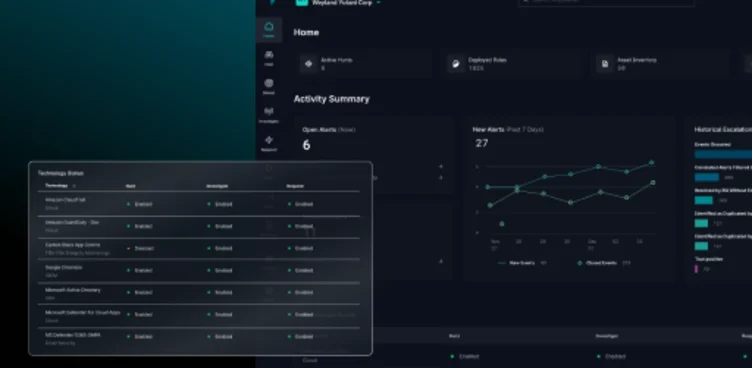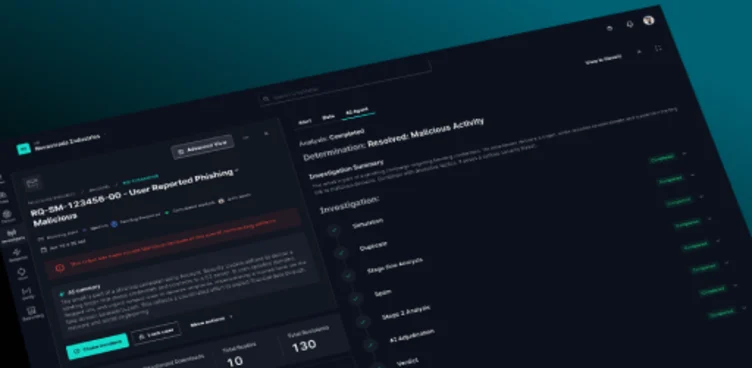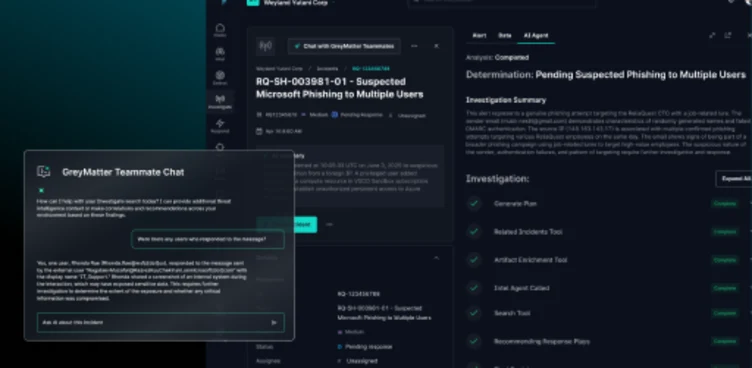
At the Mandalay Bay Convention Center, you could measure how fast the market is moving by counting the signs that read "Agentic AI" over the booth. The label was everywhere. What it actually meant changed booth to booth—and that is the problem you carry home.
The stakes behind the noise are real. The fastest data exfiltration ReliaQuest tracked in 2025 took 6 minutes, and any actor with the right model can now run advanced, targeted attacks at enterprise scale. A human watching an alert queue cannot match that pace.
Now the badges are in a drawer and the follow-up emails are rolling in, every one of them promising agentic AI. The useful question to ask yourself as you filter through your inbox on the flight home is not "who said agentic?" All of them did. It's "how does this actually work, and will this strengthen my defense?"
Agentic defense is an approach to security operations where autonomous AI continuously understands the environment, reasons over risk, configures proactive measures, and coordinates defensive action across the tools and data already in place. Done well, it gives defenders more speed and scale, and the ability to operate effectively without being an expert in every tool or discipline. Identifying a comprehensive agentic AI solution from a repackaged claim comes down to a short list of criteria. Each one maps to a question you can tie directly to a vendor before agreeing to a second meeting.
1. Autonomous Execution, End to End
A complete solution runs the full range of SOC work autonomously—not just incident response, but detection engineering, threat hunting, threat intel research, and IT and OT coverage—across your tools and approved workflows, while defenders keep control of the decisions that matter. The tell on the floor was scope: many demos automated one scripted step in one discipline and handed the rest back to an analyst. The ones worth a second meeting ran continuously, and collaboratively, across every discipline and closed the loop without a human stepping in to finish the job.
Ask the vendor:
Does your AI run end to end across disciplines—investigating every alert, building and deploying detections, hunting proactively, and covering OT—or does it automate one step and hand the rest back to an analyst?
2. Knowledge of the Opponent
Autonomy without context is fast guessing. Real defense is shaped by threat intelligence, attacker behavior, known exposures, and the attack paths most likely to be used against a specific environment. On the floor, this showed up as a clean split: tools that score generic risk versus systems that reason over what an attacker would plausibly do next. The deeper question is where that intelligence originates—whether a vendor generates its own or resells someone else's.
Ask the vendor:
Where does your threat intelligence come from?
Do you run your own researchers—boots on the ground producing native intel and threat research—or are you repackaging third-party feeds?
Does your AI apply that intel to my environment continuously, or reason only over data inside your own platform?
3. Coverage Across Your Existing Architecture
A comprehensive solution works across your existing tools, clouds, SIEMs, and data stores without forcing everything into one platform. This is where the show floor divided. Many pitches quietly assumed you would centralize your data in their lake first, which resets your architecture on their terms and creates blind spots for data too expensive or too sensitive to move. The stronger model normalizes telemetry from any vendor at the field level without centralizing it, and runs detection at the source, at storage, or in motion as data moves—without requiring a SIEM.
Ask the vendor:
Does this require my data to land in your platform before detection can run, or can it normalize across my existing tools and detect at the source, at storage, and in motion without requiring a SIEM?
4. Plain-Language Operation for Anyone on the Team
Most security tools gate their power behind syntax: to run a hunt, you first have to know how to write one. A comprehensive solution understands a defender's intent in plain language and coordinates each request across the environment—build detections, run hunts, investigate alerts, and execute response without knowing SPL, KQL, or any vendor-specific syntax. This week reinforced how much of the "skills shortage" is really a syntax and tooling problem. When the interface is intent instead of query language, the pool of people who can do the work expands immediately.
Ask the vendor:
Can an operator who doesn't know query syntax build a detection, run a hunt, and execute a response entirely in plain language, or does your demo still require an expert to phrase the request?
Raise the Bar on the Follow-Up
The market adopted agentic language faster than agentic operation. That gap is normal for any inflection point, and it's the opening for security leaders to raise the bar as the follow-ups begin. Any vendor can demo one of these four in isolation. A comprehensive agentic AI solution answers all four at once—executing autonomously across every discipline, reasoning over intelligence it generates itself, covering your existing architecture without moving your data, and operating in plain language for anyone on the team. This combination set the bar. Take the four questions into every follow-up conversation, and look out to see them answered live, before a POC ever gets signed.