ReliaQuest has released a new GreyMatter Agentic Teammate that enables security teams to build, tune, and manage detections using natural language prompts.
Traditionally, detection engineering has been an infamously slow and complex process. Doing it manually requires days of work spent researching threats and designing and translating logic across tools before you can test, validate, then eventually deploy new rules.
Security teams know what threats target their industry. But manual detection engineering consumes the capacity they need to approach it proactively. Instead of focusing on what threats matter most, teams get stuck manually translating logic across platforms and maintaining time-consuming detection builds that stunt growth.
ReliaQuest is addressing this gap with its GreyMatter Detection Engineering Teammate, a new agentic AI capability that can reduce 70% of the time spent on manual detection engineering by building, tuning, and deploying detection rules across integrated technologies from natural language prompts.
Solving the Multi-Tool, Multi-Language Problem
Many tools can generate detections. But analysts need to learn their query languages to use them, then continuously pivot across tools and platforms to manage detection logic for each tool.
GreyMatter’s Detection Engineering Teammate pairs natural language interaction with the Universal Translator, which normalizes detection logic across integrated technologies. These combined capabilities allow teams to automate the detection building, tuning, and management processes across all integrated tools using only natural language.
Your New Detection Engineering Teammate in Action
By simplifying and accelerating detection rule creation, testing, and tuning, the Detection Engineering Teammate enables security teams to analyze threat research for new detection use cases—shifting focus from how to detect to what should be detected.
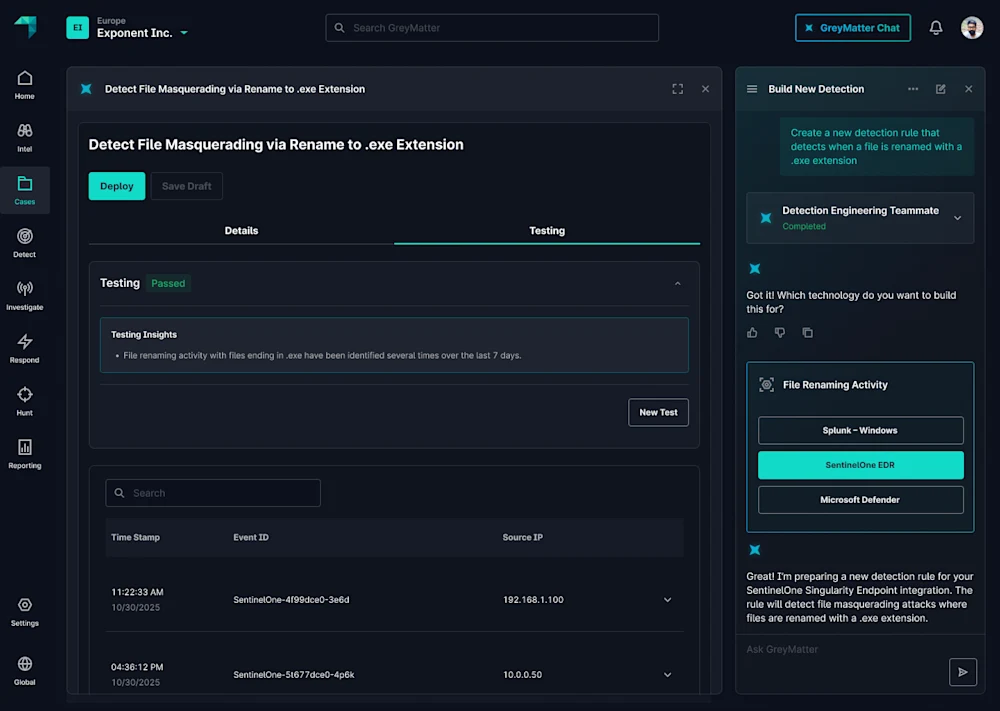
Consider how this works in a SOC. Say a detection engineering team needs to build a detection for a common threat targeting their industry that attempts to evade security controls and deceive users into executing malicious content.
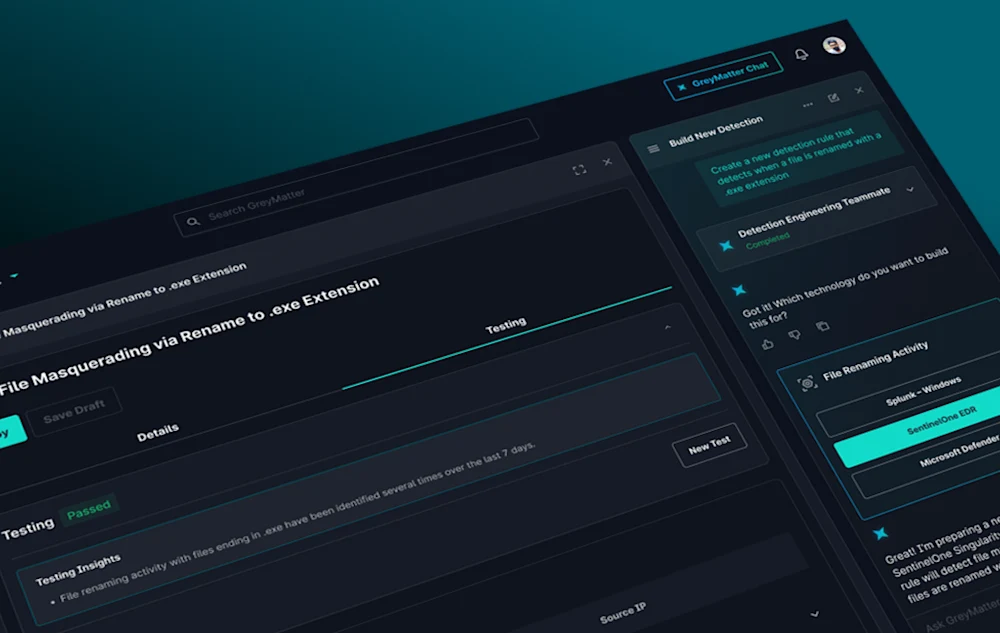
A SOC operator would submit a natural language prompt in GreyMatter Chat: "Create a new detection rule for my EDR that detects when a file is renamed with a .exe extension”
From there:
The Teammate translates the intent and generates proposed logic tailored to the operator's environment, while flagging any overlaps with existing rules.
The operator reviews the proposed logic and can adjust it using natural language if needed.
The Teammate tests the detection logic against historical data from the operator’s environment to validate fidelity and flag any gaps.
Once the operator approves the results, the Teammate deploys the new detection rule for the associated technology.
Traditionally, this process takes hours or days of manual research, multi-platform testing, and validation. With the Detection Engineering Teammate, the entire workflow runs in minutes while keeping humans in the loop.
Key Benefits The Detection Engineering Teammate helps SOC teams to:
Simplify detection building: use natural language to create new detections unique to your environment.
Optimize coverage: tune rules, improve detection efficacy, and implement new response playbooks.
Scale expertise: prioritize threat research and new use case development while automating routine detection maintenance.
Scale Detection Engineering Across Your SOC
The Detection Engineering Teammate joins ReliaQuest's GreyMatter Agentic Teammates, role-based agentic AI personas built on more than 15 years of frontline security operations experience. These Teammates operate within the GreyMatter agentic AI security operations platform and collaborate across detection engineering, threat intelligence research, threat hunting, and operational health.
When the Threat Hunting Teammate discovers suspicious activity, Threat Intel enriches findings with personalized, actionable intelligence. The Detection Engineering Teammate then rapidly builds and validates new detection rules to catch similar activity across your environment. This integration transforms a single hunt into organization-wide improvement—each finding strengthens your detection posture.
Your organization instantly multiplies your detection coverage and expertise without expanding headcount. This collaborative approach enables teams to deploy more relevant detections faster, close coverage gaps before attacks hit, and operate with confidence knowing your detection posture matches your actual threat reality.