

For years, security operations has been defined by how fast a security team can identify and respond to threats. But AI changed the equation for both the adversary and the SOC. Responding faster is no longer enough.
At ReliaQuest, we’ve long viewed security operations as a journey that security leaders can follow to mature their operations:
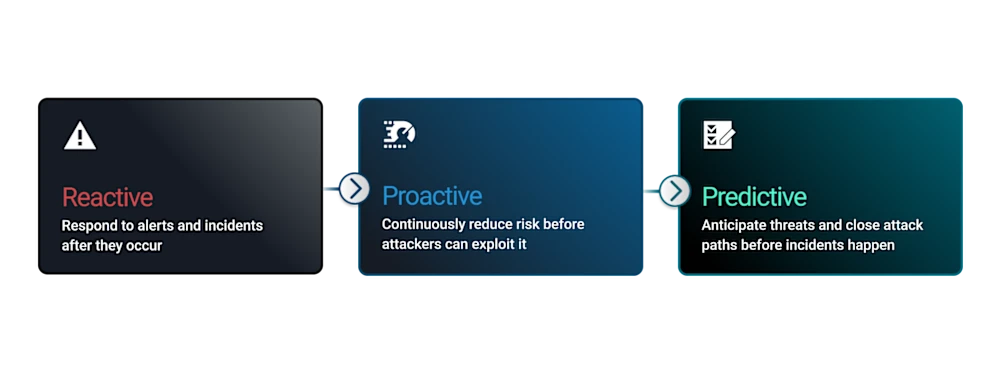
Proactive operations is the new standard for getting ahead of modern threats. Predictive operations is the goal for staying ahead of threats as they evolve. We built our agentic AI security operations platform, GreyMatter, around this conviction.
In the Proactive Security Platforms Landscape, Q1 2026, Forrester formalized the industry shift—establishing the “proactive security platform” as a defined market category and recognizing ReliaQuest GreyMatter among notable platforms.
Security Operations Has a Response Problem
Most security teams are trapped in a reactive cycle. As alert volume grows, analysts are forced to spend more time triaging and responding, leaving less time for the work that actually reduces risk. The result is a constant state of firefighting that makes it harder to anticipate future incidents.
Meanwhile, attackers are moving faster. In 2025, attackers achieved lateral movement in as little as four minutes—85% faster than the year prior. At that pace, faster response is not enough to reduce risk.
Even mature teams that invest in proactive capabilities struggle to apply them continuously or at scale. According to Forrester, the primary challenge facing the proactive security market is that “fragmented security solutions and siloed data leave teams missing the right context.”
Proactive security operations solves this challenge by unifying fragmented data and tooling into a single operational model, giving teams the context they need to act on risk before it becomes an incident.
What Is Proactive Security Operations?
Proactive security operations is the practice of continuously reducing risk before an incident occurs. Reaching that state requires operational alignment across three pillars: visibility, prioritization, and remediation.
1. Visibility
Know what's in your environment and where risk lives across endpoints, cloud workloads, identities, applications, OT/IoT, and third-party systems. Forrester says a proactive security platform “must provide a depth of asset context, such as its business relevance, data stored or transmitted by the asset, and whether security controls are appropriate and effective.”
2. Prioritization
Visibility without prioritization is noise. But just because an exposure can be exploited doesn’t mean it should be prioritized. According to Forrester, “proactive security vendors must also incorporate business context, IT operations team capacity, and the impacts of risk event modeling to show why one exposure should be remediated over another.”
3. Remediation
Forrester is direct: “a prioritized list of problems doesn’t improve security posture.” Proactive security is only possible when teams act on that knowledge—fast, consistently, and at enterprise scale. That requires a platform that goes beyond opening tickets, integrating directly with patching, configuration management, and security controls to close exposures before adversaries reach them.
Each pillar is essential, but they’re only effective in achieving proactive security operations when all three work together.
The Journey from Reactive to Proactive—and Toward Predictive
We built GreyMatter on the conviction that the only way to outpace advanced adversaries is to proactively reduce risk.
Break Free from Reactive Work
GreyMatter ingests and correlates telemetry across your entire security stack, then applies agentic AI to autonomously investigate and respond to 100% of alerts across 250+ technologies with 99.4% accuracy. Threats are contained in under five minutes—closing the window before attackers achieve lateral movement.
By eliminating Tier 1 and Tier 2 manual work, GreyMatter frees analysts to focus on higher-value, proactive initiatives.
Scale Proactive Operations Across the Enterprise
Getting out of reactive mode creates capacity that GreyMatter enables with native proactive capabilities most SOCs struggle to build and sustain on their own:
Dark web monitoring and digital risk protection to identify external threats before they reach your perimeter.
Continuous asset discovery to maintain a live inventory of every asset, entity, and exposure across your environment.
Threat hunting to proactively search for adversary activity across 250+ technologies.
Threat intelligence research that connects external risk from the open, deep, and dark web with your internal environment.
Agentic Teammates Make Proactive Capabilities Predictive
Forrester calls agentic AI the leading disruptive force in proactive security — but observes that for most vendors, AI "isn't yet changing how proactive security teams work." For GreyMatter customers, it already has.
GreyMatter's Agentic Teammates use over 200 agents and 400 AI tools to operationalize proactive capabilities at machine speed — autonomously executing threat hunts, generating and deploying detection logic, producing tailored intelligence reports, managing infrastructure health, and bridging OT/IT environments. Work that used to require dedicated teams running manual processes now runs continuously and without human intervention.
Together, these Teammates transform proactive capabilities into autonomous predictive operations.
GreyMatter's network effect amplifies this further. Threat intelligence and detection logic are shared across the full ReliaQuest customer base. When adversary behavior is observed in one environment, protections are applied across all.
Proactive Security Is the New Standard
For years, proactive security was treated as aspirational—a maturity milestone teams would reach once they cleared their alert queue. But AI has made that operational model obsolete.
To us, Forrester's Proactive Security Platforms Landscape reflects what we’ve seen across thousands of enterprise environments: breaches are rarely the result of a single missed vulnerability. They are the result of chained exposures, missed signals, and delayed response. Breaking that chain requires consolidated visibility, intelligent prioritization, and automated remediation working continuously and at scale.
Proactive security is no longer a theoretical future state. It is the required standard.
We believe ReliaQuest was recognized by Forrester as a proactive security platform because GreyMatter was built to enable exactly this shift—giving security teams the speed to move away from reactive operations, the capabilities to scale proactive programs, and the foresight to become predictive.
Forrester does not endorse any company, product, brand, or service included in its research publications and does not advise any person to select the products or services of any company or brand based on the ratings included in such publications. Information is based on the best available resources. Opinions reflect judgment at the time and are subject to change. For more information, read about Forrester’s objectivity here.