Skip to Content

In This Guide:

Setting up a detection strategy? Not sure where to start? This checklist provides you with the steps you need to take to get your program off the ground.

We’ll divide the steps by each of the 4 phases of detection engineering—including building a library, testing your detections, deploying your detections, and measuring success—so your bases are covered, and you can get up to speed quickly.

4 Phases of Detection Engineering

Use each checklist item as a structured roadmap to build a scalable detection program.

Step 1: Research and Build Your Detection Library


Why: Building a comprehensive detection library, rather than creating one-off detections, fosters a strong, proactive, and adaptable strategy.


Assess your needs: Identify the biggest risks to your organization and critical assets that need protection. You may also want to take into account the results of penetration tests, any emerging threats to your industry, or past cyber incidents.

Prioritize top detections: Based on your research, rank your most-needed detections and determine how to allocate your resources.

Identify needed data sources: Some detections may require diverse data sources for comprehensive visibility and quick threat identification. Make sure you know what those are in advance.

Determine detection authors: Include detections from technology vendors, internal teams, and third-party providers for a multi-layered detection strategy.

Put it all together: Once you have all these pieces, craft and document your detections.


Step 2: Test and Validate Your Detections


Why: Ensure your detections effectively identify the intended threats without triggering too many false positives or negatives.

Validate logic syntax: A misplaced (or missing) semicolon can break a detection’s function. Use a syntax validation tool to make sure that the detection logic is error-free.

Confirm Data Availability: Double-check that the data you identified earlier is properly connected, ingested, and stored.

Test your Detections with Simulated Attacks: Test the detection logic against real-world scenarios to validate that it identifies the intended threat.

Revisit Performance: Once your detection has been running in your environment for a while, go back and check its performance over time.


Step 3: Determine How You Will Deploy Detections


Why: To detect ubiquitous threats that vary in sophistication and speed, you need to assess two key ways to detect threats for your architecture.

Enabling detections at source or in transit is the best way to stop threats earlier, reduce dwell time, and increase efficiency. By detecting threats without relying on a SIEM, you can reduce what’s stored, minimize delays and cut storage and ingestion costs.

Analyze detection requirements: Does a rule require data from multiple sources?Is it an out-of-the-box detection from a vendor?

Assess technologies and capabilities: Do the necessary APIs exist to support at-source detections?

Understand associated costs: For at-source detections, API/CPU limits may come into play. If you’re detecting at storage, sending data to the SIEM may overload your storage costs.

Architect your strategy: Document which detections apply to each technology and record within your library.


Step 4: Measure Performance


Why: The only way to know if your detections are working is to measure their results.

Align to a framework: Compare your detection capabilities with frameworks like MITRE ATT&CK to assess effectiveness and identify gaps.

Develop key metrics: Develop and monitor KPIs to understand detection gaps, track false positives, and measure threat detection time.

Rewrite based on performance: If you’re not hitting your KPIs or missing threats, review and rewrite your detection logic or build anew.


Consider a Centralized Strategy

The most efficient detection strategy requires centralizing the management and deployment of detection rules. With this approach, called detection orchestration, security operations teams can build a single rule that can deploy across their environment, whether on-premises, in the cloud, or hybrid.

The ReliaQuest GreyMatter Agentic AI Security Operations Platform

Detection engineering isn’t just about building detections; it’s about building a system that evolves, adapts, and outpaces attackers. Security teams that understand this thrive in a world of constant cyber risk. By treating the detection lifecycle as an ongoing, strategic process, you’ll not only detect threats more accurately but also maintain an environment that can withstand the evolving tactics of adversaries.

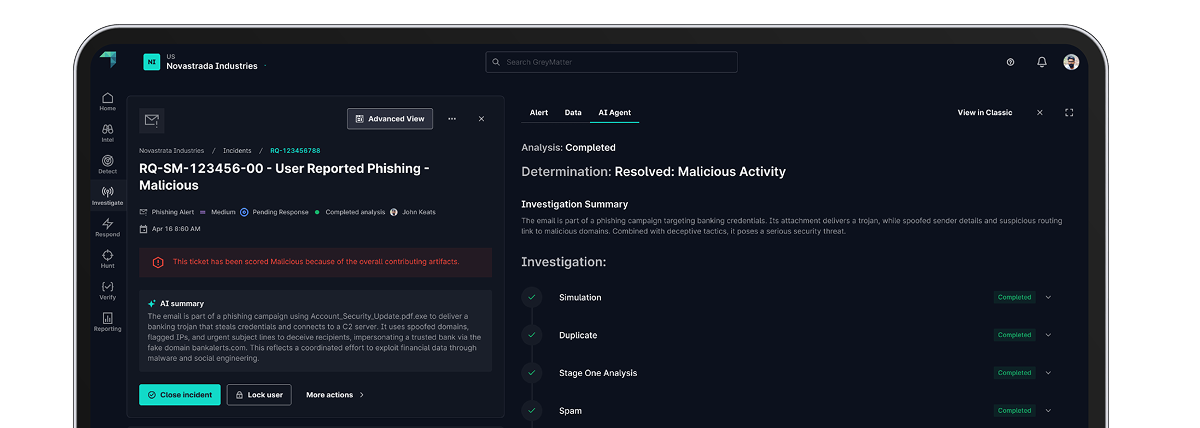
Detection engineering is an integral aspect of detection orchestration, the most effective detection-handling strategy for modern SOCs that want to keep up with evolving threats. This unified and efficient approach to threat detection centralizes the management and deployment of detection rules, enabling seamless implementation and updates across diverse environments. ReliaQuest’s Agentic AI Security Operations Platform, GreyMatter, empowers enterprise security teams to leverage their current or future technology stack to drive greater visibility and automation without the need to centralize data or standardize tools.

GreyMatter: Taking SecOps from Reactive to Proactive to Predictive

GreyMatter | Content & Media | Product Image

Break from Reactive

Unify your tech stack, detect faster, and contain threats in minutes. Offload Tier 1 and Tier 2 work to AI so your team can start thinking forward.

Get Proactive

Gain full visibility of assets, identities, and external risks so you can hunt threats, manage exposures, and harden defenses.

Predict Tomorrow

Risk-aware Teammates can help you surface threats early and evolve your security program based on threat trends.