Skip to Content

A New Era for Security Detection

As a security leader, your mission is to enable the business to move fast while managing risk. Yet the standard playbook for detection—the cornerstone of any security program—is slowing you down and introducing risk.

Imagine your firewall detects suspicious traffic, but the data has to flow to your SIEM, get ingested, and trigger correlation before an alert fires. Valuable hours pass before your team sees it. Meanwhile, you’re paying to store every byte of that data, including logs that never trigger a detection. If you try to cut costs by forwarding data selectively, you sacrifice comprehensive visibility—you're forced to choose.

Leaders can simultaneously achieve speed, cost, and visibility by adopting a new strategic mindset: detection optionality. This approach decouples detection from data storage and empowers you to choose the most effective and efficient way to detect threats.

Diagnosing the Problem: Three Cracks in the Detection Foundation

The default detection architecture is made up of siloed tools and a slow, centralized SIEM, creating blind spots and delays that leave your business at risk:

The Architectural Risk


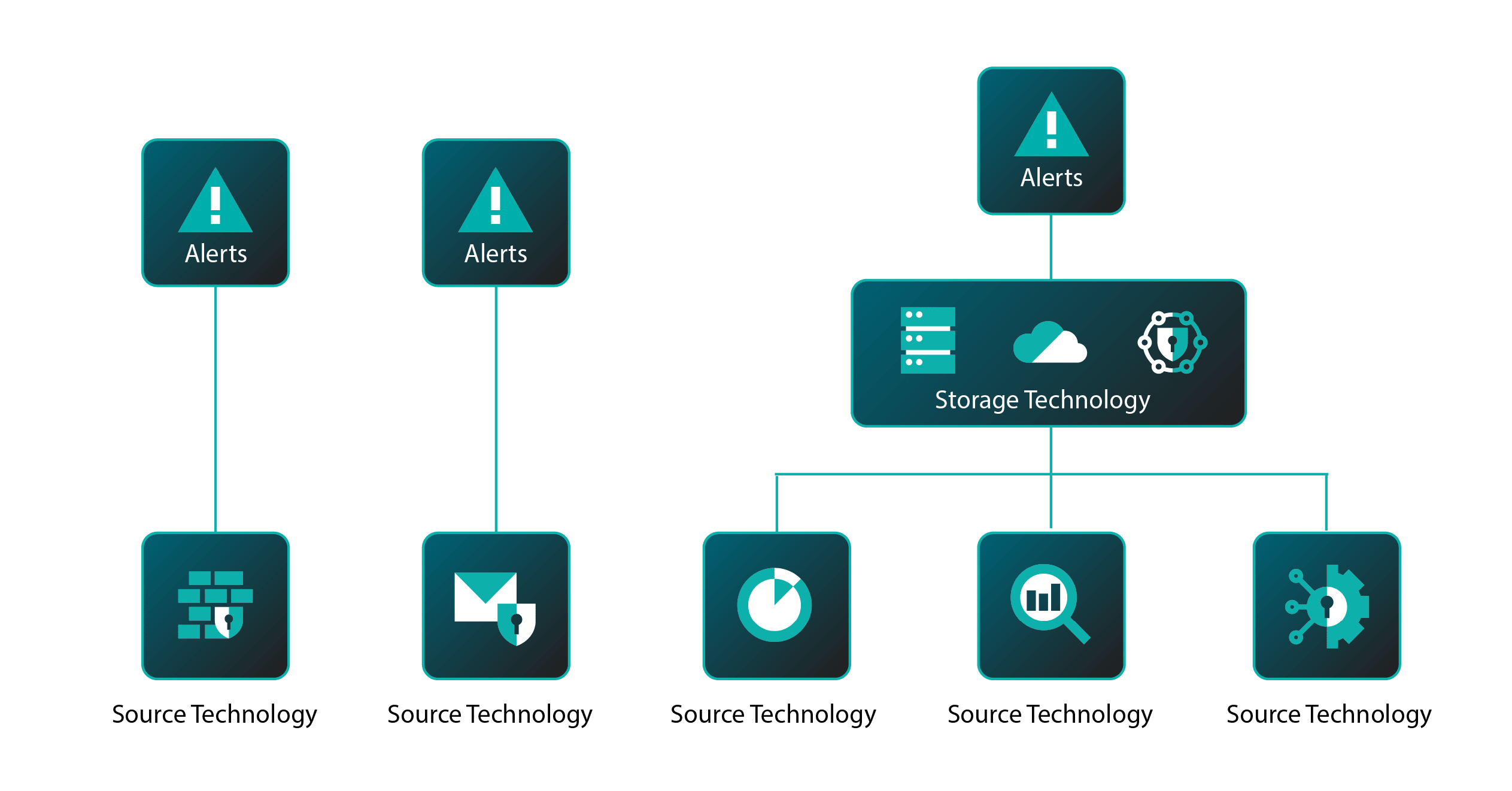
Your EDR spots lateral movement in real-time. Your cloud platform detects unusual API activity. But they don't correlate, so a threat that's obvious when you connect three data sources stays invisible because those sources live in separate tools. This disjointed system is neither fast nor intelligent enough to outpace a modern adversary, forcing teams into a reactive posture.

The Financial Risk


The natural fix is centralization: Throw all your data into a SIEM and build correlation rules. But you end up paying to store and process months of data that your detection rules never actually touch. This "data tax” forces a false choice between comprehensive visibility and budget reality, diverting funds from proactive security initiatives to data warehousing—often for data that delivers little detection value.

The Operational Risk


With detection logic scattered across dozens of tools, there is no central control plane to ensure consistency. This forces your expert teams into manual cycles of updates and tuning across disparate systems, resulting in team burnout and persistent blind spots.


What is the Data Tax?

The "Data Tax" is the storage and ingestion fees incurred when forwarding every byte of security data to a SIEM or storage tool for detection, including irrelevant data that goes unused for detection.

Detection Optionality | Image | Diagram of a Fragmented Detection Environment

The New Playbook:

The Three Paths to Detection

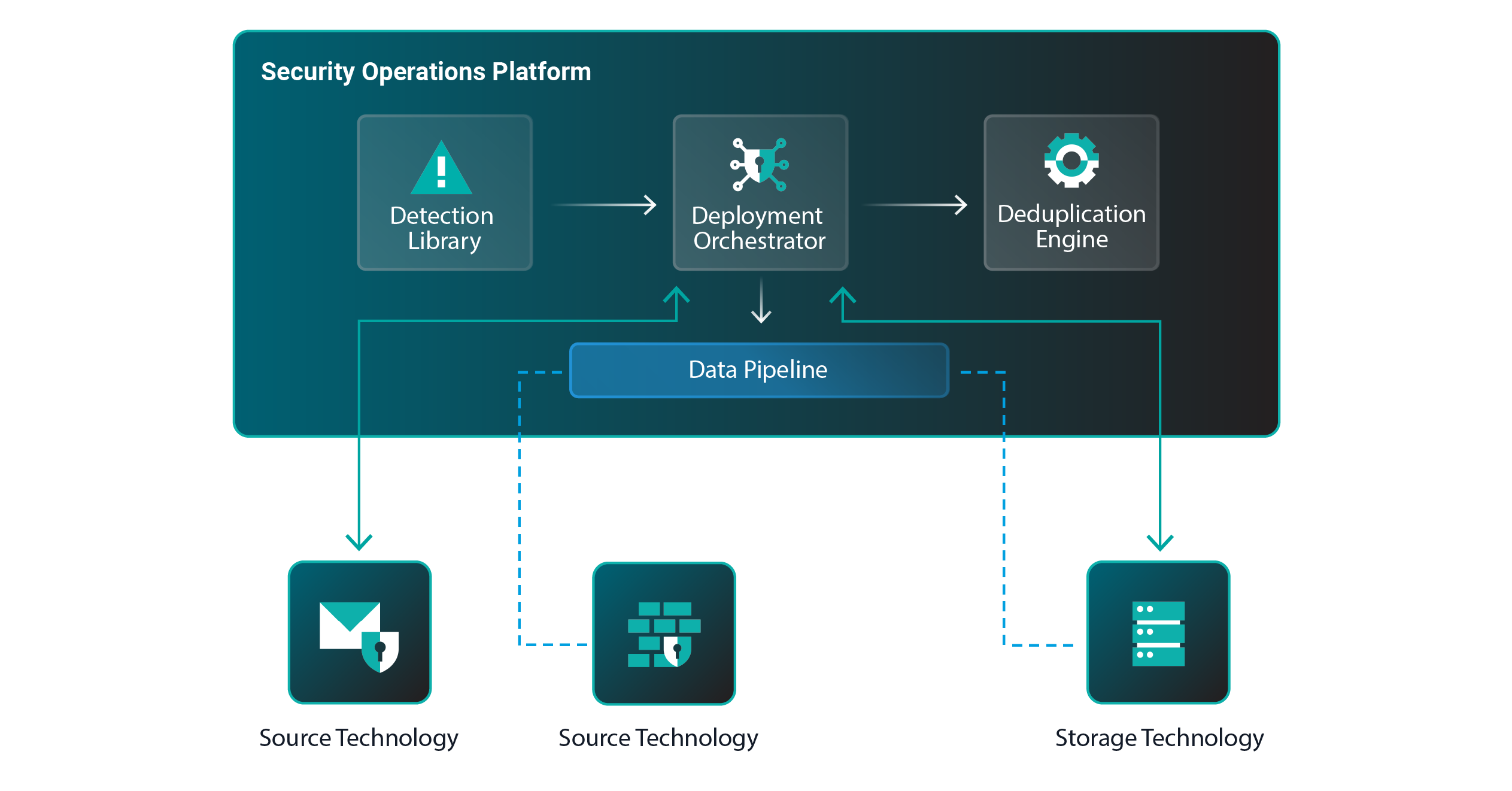
Detection optionality breaks these constraints by granting you the freedom to choose the best detection method based on the threat type, the data's value, and the risk to your business. Centralized detection management orchestrates detection across three distinct locations:

Detection Type

How it Works

Key Benefits

Ideal Use Cases

At Source

Queries data directly where it's logged through API integration, using native capabilities of critical security tools. A central platform queries the source and receives results without moving raw data.

Real-time visibility into high-fidelity data; bypasses ingestion/processing delays.

EDRs, cloud workloads, and identity solutions.

In Transit

Utilizes a data pipeline to inspect high-volume data in a pipeline after it leaves the source but before costly storage. Data is analyzed for threats, then routed or discarded.

Eliminates the data tax by controlling ingest costs. Provides architectural optionality in storage, reducing the mean time to detect.

Firewall traffic, DNS queries, and OS Logs.

At Storage

Leverages existing SIEM or data lake for deep, cross-telemetry correlation on essential retained data. SIEM becomes a powerful tool for specific, high-value use cases.

Excels at deep investigations and complex analytics.

Complex, historical detections requiring long-period, multi-source correlation.

Detection Optionality | Image | Arch Diagram

Selecting the Right Mix of Detection Authors

Detection optionality isn't just about where and how you detect threats; it also means flexibility in where your detection rules originate. A truly robust detection program integrates and unifies logic from diverse sources, including:

  • Your internal security teams, empowering them to build and customize detections tailored to your unique risks

  • Your technology vendors, allowing you to retain and leverage their specialized, pre-built rules already embedded in your source systems

  • Trusted third-party providers, ensuring you can incorporate external threat intelligence and best practices

The result is a multisourced, adaptable detection library with consistent data standards and quality controls, all managed from a single platform.

How Optionality Benefits the Business

<h4><b>Outpace Business Risk</b></h4><p></p>

Outpace Business Risk

Compress the mean time to detect from hours to minutes, enabling faster response and turning a potential crisis into a managed event.

<h4><b>Maximize ROI and Reclaim Your Budget</b></h4><h4></h4><p></p>

Maximize ROI and Reclaim Your Budget

By opting out of the "log everything" model, you control what data to store and where, directly managing SIEM licensing and ingestion fees. Reinvest budget into proactive defense and upskill your team.

<h4><b>Build a Future-Proof Architecture</b></h4><p></p>

Build a Future-Proof Architecture

A unified management plane and vendor-agnostic architecture lets you adopt new technologies and scale your operations as your business evolves.

Gain Control of Your Detection Architecture with ReliaQuest GreyMatter

The best security teams are no longer just managing tools; their leaders are architecting for advantage. Sticking to an outdated, fractured, and costly detection strategy has become a critical liability. Detection optionality is the solution that eliminates trade-offs, putting you in control of your architecture, budget, and ability to protect the business.

ReliaQuest GreyMatter is the agentic AI SecOps platform that makes detection optionality a reality. By leveraging at-storage, at-source, and in-transit detection, GreyMatter grants you the freedom to defend your environment anywhere, any way. Eliminate delays, minimize the data tax, and build a defense that is truly your own.